















|
|---|

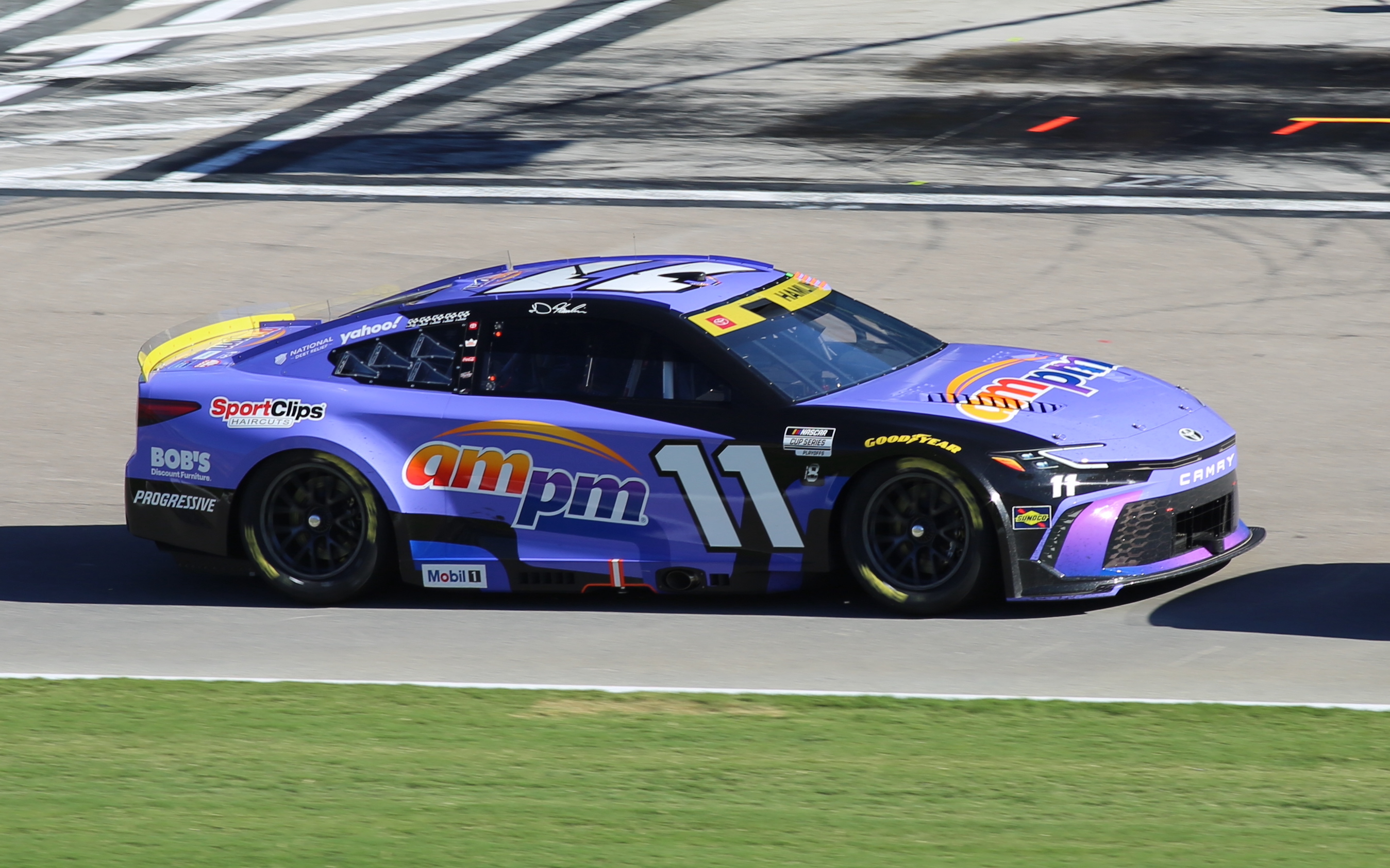
Publisher: The Crittenden Automotive Library Byline: Bill Crittenden Date: 1 January 2026 Denny Hamlin in 2010 |
Due to some late breaking news, I'm taking one last look back at 2025 before putting the awful year behind and looking forward to 2026. There's still a lot to be added to the Library, and we had a few good moments, but I've had enough of it (and the people who made it awful) for now. Sometimes NASCAR will give in to extreme behind-the-scenes pressure from the drivers or the team owners, but it's been the France family's show since the beginning. The incident at Talladega in '69 cemented the princilple that if drivers don't like it, they can leave and someone else will take their spot. No other stock car series has seen anything like NASCAR's success, there is no other way to make significant money in American stock car racing without playing by NASCAR's rules, so when NASCAR sent out their new charter agreement under “take it or leave it” terms and demanded signatures within days, most took it. 23XI Racing's Denny Hamlin & Michael Jordan, and Front Row Motorsports' Bob Jenkins, filed their lawsuit in 2024 instead. Hamlin ran the 2025 season in the shadow of this lawsuit, taking six victories (the most of any driver last year) and and came within a few car lengths of wining the championship. By that one statistic alone, and perhaps because Denny would have won under the 2014-2015 rules, it feels like Denny was robbed of his long-awaited first Cup title by the playoff system that tries to create drama up until the very end of the season and rewards championships to drivers who do well at Phoenix Raceway. However, it was Christopher Bell's four-win, 22-top 10, 3 DNF season of steady performance that would have made him champion under multiple points formats from 1952-1967 and 1973-2013. Maybe NASCAR saw that fans had had enough of this contrived drama and released a 2026 schedule without noting playoff races. NASCAR may not bend to the pressure from drivers it sees as replacable contractors, but it will occasionally listen to its customers, the fans. Following this heartbreak, and a testimony in the trial by Jim France that fans described as disastrous, NASCAR settled the charter lawsuit on December 11. Speaking of the testimonies, tip of the hat to whomever tried playing the Chicago Bulls intro song on their phone when Michael Jordan arrived at the courthouse. Being a championship contender and the most public figure of the three made Denny the unofficial spokesperson of the lawsuit group, a role he embraced on The Site Formerly Known as Twitter. But Denny is no stranger to controversy whether it's behind a steering wheel, a microphone, or a smartphone. His Twitter feed had become just a little endearing, to where I at least considered him a well-meaning doofus when he made a mis-step. He also had the most to risk, with his entire career and fortune tied to NASCAR. The settlement was a massive victory for him, and successfully challenging three quarters of a century of iron fisted rule carves a permanent place for him in NASCAR history. Given the contentious nature of litigation I imagine the Frances don't want that place won't be in the NASCAR Hall of Fame... But Denny wouldn't be able to celebrate for very long. On December 28, a house fire took the life of his father and severely injured his mother. Side note, the NBC headline in that last link reads “NASCAR legend Denny Hamlin,” and given what he just accomplished, it fits. Taking into account that Denny just turned 45, and his life just got turned upside down, and it's the offseason, folks are speculating if he's going to take the opportunity to retire. Sixty wins, three of them at the Daytona 500, it's an impressive career. But those second place finishes in the points in 2010 & 2025 might have him coming back. He can't even claim “best driver who never won a championship,” coming in second place in that comparison to Mark Martin's five runner up seasons. Denny, along with his partners, stepped up and took on the risk and expense to make NASCAR better for all of the teams involved. He deserves a good ending to his career, even if it will never be as good as it should be given that his father won't be there to see it. I hope he gets it anyways. | ||||
629.2
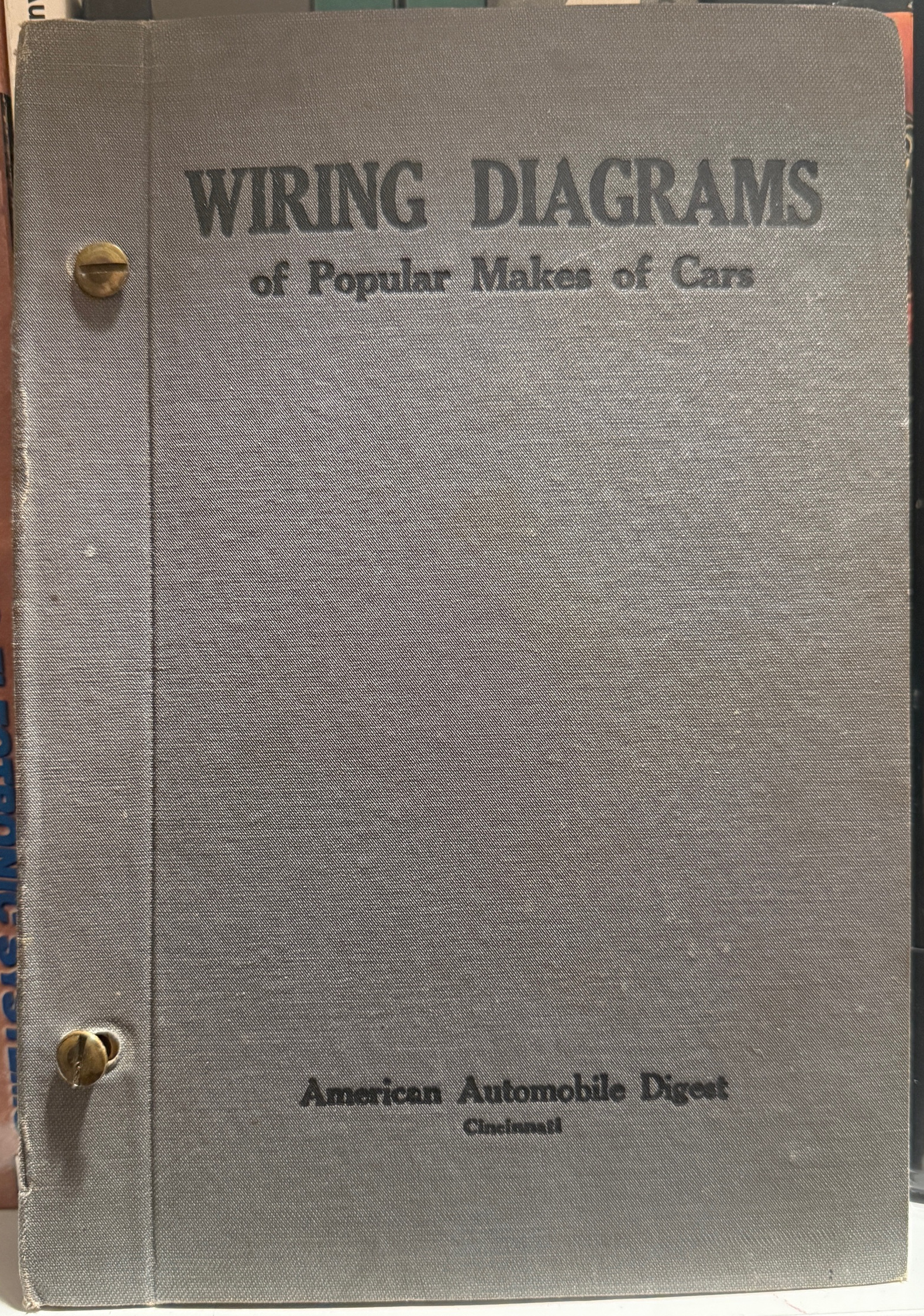
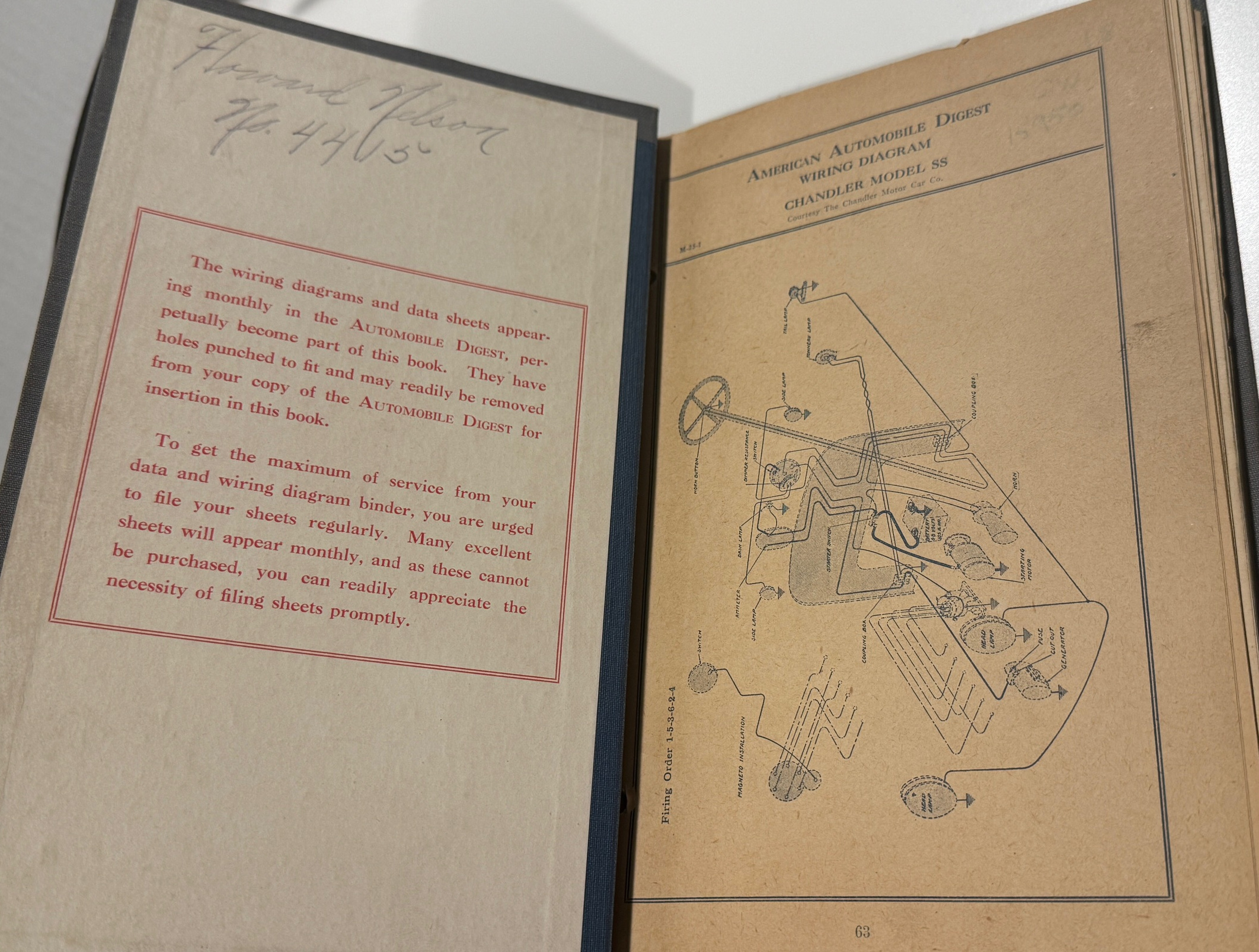
The Dewey Decimal System's designation for automobiles falls within the 629.2 range. This section is about the printed materials in The Crittenden-Walczak Collection. This month's interesting find isn't exactly a book, but it's a century old and there aren't many images from it that are publicly available. Subscribers to American Automobile Digest would receive a wiring diagram with holes punched in it that they could add to this binder made for them. The magazine existed from around 1918-1929 as best as I can tell, and a quick flip through the pages shows cars from 1922-1924.
It's amazing to see entire wiring diagrams on a single small sheet of paper when modern cars have entire manuals dedicated just to the electrical systems. It's interesting to see old repair literature not only for the few people who might possess one of these antiques but also for the context it provides to an era where repair techniques were limited by the rudimentary tools a mechanic could aquire. I've seen references in other materials to shops using pulleys from the rafters to lift a car by the front or rear bumper. I wouldn't recommend doing that on a modern car! The hydraulic lift was invented in 1925, and I would imagine a lot of small shops couldn't afford one in its early days. I'm still clearing out a space for the scanning desk, but in the meantime these pages will fit on the old scanner so I've brought that over and placed it in a corner of my main desk (the bookedge scanner won't fit there, that still has to wait). | ||||
|
History Beyond the Bumpers
The Crittenden Automotive Library includes information from all aspects of automotive transportation and competition. This section highlights topics related to automobiles other than vehicles themselves. Imagine having some form of time travel that allowed you to hand the blueprints of the new Ford Mustang to Henry Ford himself. What could he possibly do with them, even assuming they were printed out and not on a hard drive? Besides the obvious lack of computer components and LEDs, industry at the time did not have enough precision to manufacture them even if they were given that knowledge. Or the precision to manufacture the engines and transmissions specified. Could he even work on one given modern repair parts but the tools of the era? At the Auburn-Cord-Duesenberg Museum, at the National Automotive and Truck Museum, at antique shops, and in my own garage reorganizing John's toolbox, it's been enlightening to see and hold some antique tools. We have the benefit of working on simpler older machinery with modern precision tools and daylight LEDs, and it feels easy. I can remember having to use a metal cage light with an incendescent bulb, but at least my 90s Craftsman & Snap On tools were strong and precise and my instructions from Alldata were accurate. Plugging in the reader and tracking down the causes of all the computer codes can be annoying, but just imagine using an oscilloscope to measure engine performance instead. Sure, there's a generation that mastered its use and had a hard time adapting to the rudimentary first generation OBD systems, but starting from scratch in the field today? The code scanner is far superior as long as you're working on a car it can plug in to. I don't think an oscilloscope could even connect to a new car with the ignition coils on top of the spark plugs. When we're surrounded by modern tools, in a modern shop, and given the context of modern manufacturing it can be confusing wondering why past generations did things the way that they did. Why wasn't this component made stronger? Why does this cut look sloppy? Why can't this engine run more efficiently? They were doing the best they could with the materials and machinery and tools they had at the time. Those industries grew up with and alongside the automotive industry, helping each other advance each year. Perhaps no one embodies this more than Elwood Haynes, who owned the Haynes Automobile Company. While working on metals for use in spark plugs, he created an alloy called stellite and founded the Haynes Stellite Company to sell it. The metal was incredibly useful in increasing the precision and reliability of machine tools, which then fed back into improving the automobile industry. All done in workshops and factories in the days before the inventions of the calculator and fluorescent lighting. Oh, and also before the aforementioned hydraulic automotive lift. But not before the invention of the accountant, who has been there since the beginning, ensuring that price points are adhered to in both engineering and manufacturing. It's amazing that automakers and mechanics were able to do so much with almost nothing that we take for granted today. | ||||
|
Telemetry CarsAndRacingStuff.com site statistics.
The five most popular pages for the month of December (not counting basic index pages) were...
| ||||
|
About The Crittenden Automotive Library The Crittenden Automotive Library @ CarsAndRacingStuff.com, based in Woodstock, Illinois, is a free online collection of information relating to not only cars, trucks, and motorcycles, but also the roads they drive on, the races they compete in, cultural works based on them, government regulation of them, and the people who design, build, and drive them. We are dedicated to the preservation and free distribution of information relating to all types of cars and road-going vehicles for those seeking the greater understanding of these very important elements of modern society, how automobiles have affected how people live around the world, or for the general study of automotive history and anthropology. In addition to the historical knowledge, we preserve current events for future generations. The Library currently consists of over 900,700 pages of books, periodicals, and documents, over 58,800 individual articles, more than 18 days of video & 24 days of audio, more than 36,100 photographs & other images. About The Crittenden-Walczak Collection The combined personal collections of John Walczak & Bill Crittenden provide reference materials for The Crittenden Automotive Library. The collection currently includes 1,688 different book volumes/editions, 3,729 unqiue periodical & catalog issues, as well as booklets, brochures, photographs, event programs, trading cards, and 382 hours of video. |
||||