















Federal Motor Vehicle Safety Standards; Metric Conversion |
|---|
 Topics: National Highway Traffic Safety Administration, Federal Motor Vehicle Safety Standards
|
Barry Felrice
Federal Register
March 15, 1994
[Federal Register: March 15, 1994]
=======================================================================
-----------------------------------------------------------------------
DEPARTMENT OF TRANSPORTATION
National Highway Traffic Safety Administration
49 CFR Part 571
[Docket No. 93-87; Notice 1]
RIN 2127-AF03
Federal Motor Vehicle Safety Standards; Metric Conversion
AGENCY: National Highway Traffic Safety Administration (NHTSA), DOT.
ACTION: Notice of proposed rulemaking.
-----------------------------------------------------------------------
SUMMARY: This notice proposes to revise selected Federal Motor Vehicle
Safety Standards (FMVSS) by converting English measurements specified
in those standards to metric measurements. This proposed rulemaking is
the first of several that NHTSA will undertake to implement the Federal
policy that the metric system of measurement is the preferred system of
weights and measures for United States trade and commerce. The proposed
conversions are not intended to make any changes in the stringency of
the affected FMVSS.
DATES: Comments must be received on or before May 16, 1994.
ADDRESSES: All comments should refer to the docket number and notice
number in the heading of this notice and be submitted, preferably in
ten copies, to: Docket Section, room 5109, National Highway Traffic
Safety Administration, 400 Seventh Street, SW., Washington, DC 20590.
Docket hours are 9:30 a.m. to 4 p.m., Monday through Friday.
FOR FURTHER INFORMATION CONTACT: Mr. Kevin Cavey, National Highway
Traffic Safety Administration, 400 Seventh Street, SW., Washington, DC
20590. Mr. Cavey's telephone number is: (202) 366-5271.
SUPPLEMENTARY INFORMATION: Section 5164 of the Omnibus Trade and
Competitiveness Act (Pub. L. 100-418), makes it U.S. policy that the
metric system of measurement is the preferred system of weights and
measures for United States trade and commerce. Through Executive Order
12770, Federal agencies are directed to comply with the Act by adopting
a conversion schedule for their programs by September 30, 1992. In a
Federal Register document of April 21, 1992 (57 FR 14691), NHTSA
published its plan to use the metric system in NHTSA programs, and
included an implementation schedule to convert the Federal Motor
Vehicle Safety Standards (FMVSSs).
In the document, NHTSA stated its intent to review all the FMVSSs
that the agency expects will be in effect between June 1992 and 1997,
and to the fullest extent feasible, convert English system measurements
in those FMVSSs to the metric system. In undertaking the conversion of
the measurements in the FMVSSs, the agency identified the following
steps to be taken for each standard:
1. List the values to be converted.
2. Determine whether to convert the values to an equivalent
metric unit, or to use an exact conversion.
3. For the equivalent metric unit conversions, determine any
interrelationships with other values, and the effect of conversion
on the interrelationships.
4. Determine any impact that the conversion may have on changes
in safety.
5. Undertake rulemaking to revise the standard to reflect the
converted values.
With respect to the nature of the conversions to be made, the
agency stated that NHTSA generally favored the use of equivalent
conversions because using values stated in integers would facilitate
making measurements during compliance testing. However, NHTSA indicated
that it would not use equivalent conversions where there is a specific
safety need or other reason to make an exact conversion. (To illustrate
equivalent and exact conversions, an equivalent conversion of two
inches would be 50 millimeters, while an exact conversion would be 50.8
millimeters.)
The agency anticipated that some standards will be easier to
convert than others. Therefore, the agency established the following
timetable: Simple conversions to be completed by June 1994,
intermediate conversions by December 1996, and the most complex
conversions by December 1997.
NHTSA received comments on the plan from Ford Motor Company,
General Motors Corporation, Volkswagen of America, the Association of
International Automobile Manufacturers, and Mr. John T. Benedict, an
interested citizen. All the comments supported NHTSA's approach to
making the conversions. Some commenters cautioned the agency to be
careful when rounding off metric conversions, so that the agency does
not inadvertently make the standards more stringent. NHTSA agrees that
the conversions should not inadvertently result in making the standards
more stringent. In this first round of simple conversions, NHTSA has
made the conversions using SAE guideline J916 May 1991, and Federal
Standard 376B ``Preferred Metric Units for General Use by the Federal
Government'' and then rounding the result. NHTSA acknowledges Mr.
Benedict's comment that this approach may not be suitable for the more
difficult conversions to be made in subsequent rulemkings.
NHTSA generally agrees with Volkswagen's comments that measurements
and performance requirements should be expressed in the same units in
the FMVSS, the SAE recommended practices and standards, and the
Canadian Motor Vehicle Safety Standards. The agency will follow this
practice unless adopting levels consistent with other standards would
substantively change the existing requirements in the FMVSSs. With
regard to the simple conversions proposed in this notice, the agency's
approach of making a conversion and rounding to the nearest whole
metric unit results in numbers that are consistent with voluntary
industry guidelines, such as ASTM and SAE standards.
This initial notice of proposed rulemaking identifies those
standards for which the agency believes conversions would be simple and
makes the appropriate conversions to the metric system. English
measurements in the following Federal Motor Vehicle Safety Standards
(49 CFR 571 et seq.) are proposed to be converted to the metric system:
Standard No. 102, Transmission shift lever sequence, starter interlock,
and transmission braking effect; Standard No. 103, Windshield
defrosting and defogging systems; Standard No. 104, Windshield wiping
and washing systems; Standard No. 107, Reflecting surfaces; Standard
No. 110, Tire selection and rims; Standard No. 112, Headlamp
concealment devices; Standard No. 114, Theft protection; Standard No.
115, Vehicle identification number basic requirements; Standard No.
120, Tire selection and rims for motor vehicles other than passenger
cars; Standard No. 124, Accelerator control systems; Standard No. 126,
Truck-camper loading; Standard No. 205, Glazing materials; Standard No.
206, Door locks and door retention components; Standard No. 207,
Seating systems; Standard No. 212, Windshield, mounting, and Standard
No. 216, Roof crush resistance.
I. Exact Versus Equivalent Conversions
In the majority of cases, the proposed conversions are equivalent
conversions. It is the agency's intent that, if made final, these
equivalent conversions have no substantive effect on specifications or
requirements in the affected standard. Public comment is sought on
whether each equivalent conversion would substantively affect the
regulatory text. If there would be a substantive effect, comment is
requested on the appropriate exact conversion.
In certain cases, exact conversions are proposed. Most of the exact
conversions specify the height of lettering, the minimum depth to which
the lettering must be impressed, or the maximum height to which it must
be embossed. In such situations, manufacturers typically have invested
in molds and other materials that produce lettering of very precise
sizes. NHTSA does not want the conversion of the required lettering to
have the effect of requiring manufacturers to have to change molds and
materials.
NHTSA also proposes to use exact conversions for certain other
measurements, to avoid a possibility that the standard would become
more stringent after the conversion. For each of these proposed
conversions, the agency seeks comment on whether use of the equivalent,
rather than the exact conversion, would make a substantive difference:
1. Gross Vehicle Weight Ratings (GVWRs)
When the standards proposed to be converted in this notice refer to
GVWR, the agency proposes to convert those GVWRs to the exact
conversion. GVWRs of 10,000 pounds are proposed to be converted to 4536
kilograms and GVWRs of 6,000 pounds are proposed to be converted to
2,722 kilograms. NHTSA is aware that some of the Canadian Motor Vehicle
Safety Standards use the equivalent conversions of 4500 kilograms for
the 10,000 pound GVWR and 2700 kilograms for the 6000 pound GVWR.
The GVWR conversion may affect the applicability of some of the
FMVSS's to particular vehicles. In the case of standards that apply to
vehicles with a GVWR of 10,000 pounds or less, rounding to 4500
kilograms would affect any vehicles between 4501 and 4536 kilograms
GVWR. Such vehicles may be excluded from FMVSS's that had applied to
them (e.g., Standards 118, Power-operated window, partition, and roof
panel systems, and 212, Windshield mounting, which apply to vehicles
with GVWR's of 10,000 pounds or less), or be subject to requirements
that had previously not applied to them (e.g, Standard No. 222, School
Bus Passenger Seating and Crash Protection which applies to vehicles
with GVWR's of more than 10,000 pounds).
Since the number of vehicles in the 4501 to 4536 kilogram or 2700
to 2722 kilogram ranges is likely to be very small, NHTSA requests
comments on whether the greater ease of using equivalent conversions
would outweigh the benefits of exact conversion.
2. Standard No. 110, Tire Selection and Rims
Standard No. 110 specifies at S4.4.1(b) that tire rims shall, in
the event of rapid loss of inflation pressure at a speed of 60 miles
per hour, retain the deflated tire until the vehicle can be stopped. In
this NPRM, the agency proposes that 60 miles per hour be converted to
97 kilometers per hour, the exact conversion. The Canadian Motor
Vehicle Safety Standards currently specify the requirement be met at
100 kilometers per hour, which is the equivalent conversion. The agency
seeks comment on whether there is a substantive difference whether the
conversion of 60 miles per hour is made to 97 or to 100 kilometers per
hour.
3. Standard No. 212, Windshield Mounting
Under the test conditions of S6.1(b) in Standard No. 212, certain
tested vehicles must be loaded to their unloaded vehicle weight plus
300 pounds. In this NPRM, the agency proposes to convert 300 pounds to
136 kilograms, the exact conversion. The Canadian standards have
converted 300 pounds to the equivalent conversion of 140 kilograms. In
the conversion of 300 pounds, the concern about stringency is
particularly relevant because the manufacturers' certification testing
for Standards Nos. 208, Occupant crash protection; 212, Windshield
mounting; 219, Windshield zone intrusion; and 301, Fuel system
integrity can be conducted in a single crash test. A slight increase in
the load required for Standard No. 212 testing (resulting from a
conversion to 140 kilograms) may necessitate the manufacturers
conducting a separate crash test for Standard No. 212 certification. To
avoid this situation, the agency proposes to convert 300 pounds to the
exact conversion of 136 kilograms, rather than the equivalent
conversion of 140 kilograms.
II. Labeling Information
The agency also seeks comment on proposed metric conversions of
labels providing information to consumers. Certain FMVSSs specify
labels or wording to be placed on vehicles to provide safety
information to the consumer. At present, the FMVSSs generally specify
that labels provide units measurement in the English measurement
system. When converting the FMVSSs to the metric system, the agency is
not certain that labels incorporating metric measurements would be
informative for American consumers. Therefore, in cases where labels or
other information must be provided for the consumer's benefit, it is
proposed that the information provide both the English and metric
systems of measurement. Specifically, in converting Standard No. 120,
Tire selection and rims for motor vehicles other than passenger cars,
it is proposed that in the ``TRUCK EXAMPLE,'' the GVWR and GAWRs of a
vehicle be provided in kilograms and pounds, and the inflation pressure
of the tires be provided in kilopascals and in pounds per square inch
(psi). In Standards Nos. 120 and 110, Tire selection and rims, it is
proposed that information about the maximum speed for spare tire be
provided as ``MAXIMUM 80 KM/H (50 M.P.H.)''. In converting Standard No.
126, Truck-camper loading, it is proposed that the maximum camper
weight be provided in terms of kilograms and pounds, the capacity of
the camper be stated in terms of liters and gallons of water, the
weight of bottled gas and ice in terms of kilograms and pounds, and
refrigerator capacity (for determining vehicle weight) in terms of
cubic meters and cubic feet.
If the proposed use of dual measurements is adopted as final, the
agency anticipates, at some future date, phasing out the English units
of measurement in the consumer information labels. Public comment is
sought generally on this proposed use of dual measurements for consumer
information labels, and on the period of time after which the English
units of measurement should be phased out.
III. Force Measurements
Standards Nos. 207 and 216 establish strength requirements for
occupant seats and for the passenger compartment roof, respectively.
Standard No. 207 specifies that occupant seats shall be subjected to a
force 20 times the weight of the seat. Standard No. 216 specifies that
the vehicle roof shall be subjected to a force 1\1/2\ times the vehicle
weight. These force measurements are straightforward enough when using
units of English measurement, since both weight and force are expressed
in pounds. However, the metric system expresses mass in kilograms and
force in Newtons. Thus, in converting forces to the metric system,
there will no longer be a simple one-to-one conversion when calculating
the force that should be applied. Instead, persons conducting tests
will need to measure the weight of the seat or vehicle mass in
kilograms and multiply each figure by 9.8 to convert the figure to
Newtons. In making the metric conversion of the force measurements in
Standards Nos. 207 and 216, NHTSA proposes to specify the steps of the
conversion in the regulatory language, to minimize the chance of the
wrong metric system conversion being made. Specifically, for Standard
No. 207, NHTSA proposes to amend the force measurement language to
provide that the seat shall be subjected to a force in Newtons equal to
20 times the weight of the seat, measured in kilograms and multiplied
by 9.8. For Standard No. 216, NHTSA proposes to amend the force
measurement language to provide that the vehicle roof shall be
subjected to a force in Newtons equal to 1\1/2\ times the vehicle
weight, measured in kilograms and multiplied by 9.8. Comment is sought
on this proposal to specify the calculation of the metric force
measurement for Standards Nos. 207 and 216.
IV. Documents Incorporated by Reference
Certain standards proposed to be converted in this notice
incorporate documents that express measurements in the English system.
An example of an incorporated document is SAE Recommended Practice
J902, ``Passenger Car Windshield Defrosting Systems,'' August 1964,
parts of which are incorporated into Standard No. 103, Windshield
defrosting and defogging systems. If incorporated documents are to be
consistent with rest of the standard, some conversion of the
incorporated documents might be desirable. However, since many of the
incorporated documents are documents that are published by groups other
than NHTSA, converting these documents is an exacting and time
consuming process. The agency has decided to consider converting
incorporated documents on a case by case basis at a later date.
Regulatory Impacts
1. Executive Order 12866 and DOT Regulatory Policies and Procedures
NHTSA has examined the impact of this rulemaking action under
Executive Order 12866 and the Department of Transportation's regulatory
policies and procedures. This rulemaking document was not reviewed
under Executive Order 12866, ``Regulatory Planning and Review.'' This
action has been determined to be not ``significant'' under DOT's
regulatory policies and procedures. In converting the Federal Motor
Vehicle Safety Standards from the English to the metric measurement
system, the agency proposes conversions that would not substantively
change the performance requirements of the FMVSS's. If this rule is
made final, manufacturers now providing consumer information (e.g.,
labeling) may incur minimal additional costs since they would have to
change their information to add the metric units. However, the agency
believes additional costs would be minuscule, since manufacturers
currently label and provide consumer information in English units. The
impacts of this action would be so minor that a full regulatory
evaluation for this proposed rule has not been prepared.
2. Small Entity Impacts
The agency has also considered the effects of this rulemaking
action under the Regulatory Flexibility Act (5 U.S.C. 601 et seq.). I
certify that this proposed rule would not, if promulgated, have a
significant economic impact on a substantial number of small entities.
The rationale for this certification is that no substantive change
resulting from converting the FMVSS from the English system to the
metric system will be made to the performance requirements of any of
the Federal Motor Vehicle Safety Standards. Manufacturers that qualify
as small businesses that do not now label their products in metric
units or provide consumer information in metric units would incur some
costs to include metric labeling. However, the agency believes such
costs should be minimal, given these manufacturers are currently
labeling and providing the consumer information in English units.
3. Environmental Impacts
In accordance with the National Environmental Policy Act of 1969,
the agency has considered the environmental impacts of this proposed
rule and determined that, if adopted as a final rule, it would not have
a significant impact on the quality of the human environment.
4. Federalism
This action has been analyzed in accordance with the principles and
criteria contained in Executive Order 12612, and it has been determined
that the proposed rulemaking does not have sufficient federalism
implications to warrant the preparation of a Federalism Assessment.
5. Civil Justice Reform
This proposed rule would not have a retroactive effect. Under
section 103(d) of the National Traffic and Motor Vehicle Safety Act (15
U.S.C. 1392(D)), whenever a Federal motor vehicle safety standard is in
effect, a state may not adopt or maintain a safety standard applicable
to the same aspect of performance which is not identical to the Federal
standard. Section 105 of the Act (15 U.S.C. 1394) sets forth a
procedure for judicial review of final rules establishing, amending or
revoking Federal motor vehicle safety standards. That section does not
require submission of a petition for reconsideration or other
administrative proceedings before parties may file suit in court.
Public Comments
Interested persons are invited to submit comments on the proposal.
It is requested, but not required, that 10 copies be submitted.
All comments must not exceed 15 pages in length. (49 CFR 553.21).
Necessary attachments may be appended to these submissions without
regard to the 15-page limit. This limitation is intended to encourage
commenters to detail their primary arguments in a concise fashion.
If a commenter wishes to submit certain information under a claim
of confidentiality, three copies of a complete submission, including
purportedly confidential business information, should be submitted to
the Chief Counsel, NHTSA, at the street address given above, and seven
copies from which the purportedly confidential information has been
deleted should be submitted to the Docket Section. A request for
confidentiality should be accompanied by a cover letter setting forth
the information specified in the agency's confidential business
information regulation. 49 CFR part 512.
All comments received before the close of business on the comment
closing date indicated above for the proposal will be considered, and
will be available for examination in the docket at the above address
both before and after the date. To the extent possible, comments filed
after the closing date will also be considered. Comments received too
late for consideration in regard to the final rule will be considered
as suggestions for further rulemaking action. Comments on the proposal
will be available for inspection in the docket. The NHTSA will continue
to file relevant information as it becomes available in the docket
after the closing date, and it is recommended that interested persons
continue to examine the docket for new material.
Those persons desiring to be notified upon receipt of their
comments in the rules docket should enclose a self-addressed, stamped
postcard in the envelope with their comments. Upon receiving the
comments, the docket supervisor will return the postcard by mail.
List of Subjects in 49 CFR Part 571
Imports, Motor vehicle safety, Motor vehicles, Rubber and rubber
products, Tires.
In consideration of the foregoing, it is proposed that the Federal
Motor Vehicle Standards (49 CFR part 571 be amended as set forth below.
PART 571--FEDERAL MOTOR VEHICLE SAFETY STANDARDS
1. The authority citation for part 571 would continue to read as
follows:
Authority: 15 U.S.C. 1392, 1401, 1403, 1407; delegation of
authority at 49 CFR 1.50.
2. Section 571.102 would be amended by revising S1, and revising
S3.1.2, to read as follows:
Sec. 571.102 Standard No. 102, Transmission shift lever sequence,
starter interlock, and transmission braking effect.
S1. Purpose and scope. This standard specifies the requirements for
the transmission shift lever sequence, a starter interlock, and for a
braking effect of automatic transmissions, to reduce the likelihood of
shifting errors, starter engagement with vehicle in drive position, and
to provide supplemental braking at speeds below 40 kilometers per hour.
* * * * *
S3.1.2 Transmission braking effect. In vehicles having more than
one forward transmission gear ratio, one forward drive position shall
provide a greater degree of engine braking than the highest speed
transmission ratio at vehicle speeds below 40 kilometers per hour.
* * * * *
3. Section 571.103 would be amended by revising S3; and, in S4.3,
revising paragraphs (b)(ii), (e), (g), and (h), to read as follows:
Sec. 571.103 Standard No. 103, Windshield defrosting and defogging
systems.
* * * * *
S3. Definitions. Road load means the power output required to move
a given motor vehicle at curb weight plus 180 kilograms on level,
clean, dry, smooth portland cement concrete pavement (or other surface
with equivalent coefficient of surface friction) at a specified speed
through still air at 20 degrees Celsius, and standard barometric
pressure (101.3 kilopascals) and includes driveline friction, rolling
friction, and air resistance.
* * * * *
S4.3 * * *
(b) * * *
(ii) The engine speed and load shall not exceed the speed and load
at 40 kilometers per hour in the manufacturer's recommended gear with
road load.
* * * * *
(e) One or two windows may be open a total of 25 millimeters:
(g) The wind velocity is at any level from 0 to 3 kilometers per
hour.
(h) The test chamber temperature and the wind velocity shall be
measured, after the engine has been started, at the forwardmost point
of the vehicle or a point 914 millimeters from the base of the
windshield, whichever is farther forward, at a level halfway between
the top and bottom of the windshield on the vehicle centerline.
4. Section 571.104 would be amended by revising, in S3, the
definition ``Glazing surface reference line''; and revising S4.1.2, to
read as follows:
Sec. 571.104 Standard No. 104, Windshield wiping and washing systems.
* * * * *
S3 * * *
Glazing surface reference line means the line resulting from the
intersection of the glazing surface and a horizontal plane 625
millimeters above the seating reference point, as shown in Figure 1 of
SAE Recommended Practice J903a, ``Passenger Car Windshield Wiper
Systems,'' May 1966.
* * * * *
S4.1.2 Wiped area. When tested wet in accordance with SAE
Recommended Practice J903a, May 1966, each passenger car windshield
wiping system shall wipe the percentage of Areas A, B, and C of the
windshield (established in accordance with S4.1.2.1) that (1) is
specified in column 2 of the applicable table following paragraph
S4.1.2.1 and (2) is within the area bounded by a perimeter line on the
glazing surface 25 millimeters from the edge of the daylight opening.
* * * * *
5. In Sec. 571.104, S4.1.2.1 would be amended by revising the title
of Table I; the title of Table II; the title of Table III; and the
title of Table IV, to read as follows:
* * * * *
Table I--Passenger Cars of Less Than 1520 Millimeters in Overall Width
* * * * *
Table II--Passenger Cars of 1520 or More But Less Than 1630 Millimeters
in Overall Width
* * * * *
Table III--Passenger Cars of 1630 or More But Less Than 1730
Millimeters in Overall Width
* * * * *
Table IV--Passenger Cars of 1730 or More Millimeters in Overall Width
* * * * *
6. Section 571.110 would be amended by revising, in S3, the
definitions ``Normal occupant weight,'' ``Production options weight,''
and ``Vehicle capacity weight''' in S4.4.1, revising paragraph (b); in
S6, revising the introductory paragraph, and paragraph (b); and
revising S7.1, to read as follows:
Sec. 571.110 Standard No. 110, Tire Selection and rims.
* * * * *
S3 * * *
Normal occupant weight means 68 kilograms times the number of
occupants specified in the second column of Table I.
* * * * *
Production options weight means the combined weight of those
installed regular production options weighing over 2.3 kilograms in
excess of those standard items which they replace, not previously
considered in curb weight or accessory weight, including heavy duty
brakes, ride levelers, roof rack, heavy duty battery, and special trim.
* * * * *
Vehicle capacity weight means the rated cargo and luggage load plus
68 kilograms times the vehicle's designated seating capacity.
* * * * *
S4.4.1 * * *
(b) In the event of rapid loss of inflation pressure with the
vehicle traveling in a straight line at a speed of 97 kilometers per
hour, retain the deflated tire until the vehicle can be stopped with a
controlled braking application.
* * * * *
S6 Labeling Requirements for Non-Pneumatic Spare Tires or Tire
Assemblies.
Each non-pneumatic tire or, in the case of a non-pneumatic tire
assembly in which the non-pneumatic tire is an integral part of the
assembly, each non-pneumatic tire assembly shall include, in letters or
numerals not less than 4 millimeters high, the information specified in
paragraphs S6 (a) and (b). The information shall be permanently molded,
stamped, or otherwise permanently marked into or onto the non-pneumatic
tire or non-pneumatic tire assembly, or shall appear on a label that is
permanently attached to the tire or tire assembly. If a label is used,
it shall be subsurface printed, made of material that is resistant to
fade, heat, moisture and abrasion, and attached in such a manner that
it cannot be removed without destroying or defacing the label on the
non-pneumatic tire or tire assembly. The information specified in
paragraphs S6 (a) and (b) shall appear on both sides of the non-
pneumatic tire or tire assembly, except, in the case of a non-pneumatic
tire assembly which has a particular side that must always face outward
when mounted on a vehicle, in which case the information specified in
paragraphs S6 (a) and (b) shall only be required on the outward facing
side. The information shall be positioned on the tire or tire assembly
such that it is not placed on the tread or the outermost edge of the
tire and is not obstructed by any portion of any non-pneumatic rim or
wheel center member designated for use with that tire in this standard
or in Standard No. 129.
* * * * *
(b) MAXIMUM 80 KM/H (50 M.P.H.)
* * * * *
S7.1 Vehicle Placarding Requirements. A placard, permanently
affixed to the inside of the vehicle trunk or an equally accessible
location adjacent to the non-pneumatic spare tire assembly, shall
display the information set forth in S6 in block capitals and numerals
not less than 6 millimeters high preceded by the words ``IMPORTANT--USE
OF SPARE TIRE'' in letters not less than 9 millimeters high.
* * * * *
7. Section 571.112 would be amended by revising S4.5 to read as
follows:
Sec. 571.112 Standard No. 112, Headlamp concealment devices.
* * * * *
S4.5 Except for cases of malfunction covered by S4.2, each
headlamp concealment device shall, within an ambient temperature range
of -30 degrees Celsius to +50 degrees Celsius be capable of being fully
opened in not more than 3 seconds after actuation of the mechanism
described in S4.3.
8. Section 571.114 would be amended by revising 32 and revising
S4.1, to read as follows:
Sec. 571.114 Standard No. 114, Theft protection.
* * * * *
S2 Application. This standard applies to passenger cars, and to
trucks and multipurpose passenger vehicles having a GVWR of 4536
kilograms or less. However, it does not apply to walk-in van-type
vehicles.
* * * * *
S4.1 Each truck and multipurpose passenger vehicle having a GVWR
of 4536 kilograms or less manufactured on or after September 1, 1983
and each passenger car shall meet the requirements of S4.2, S4.3, S4.4,
and S4.5. However, open-body type vehicles that are manufactured for
operation without doors and that either have no doors or have doors
that are designed to be easily attached to and removed from the vehicle
by the vehicle owner are not required to comply with S4.5.
* * * * *
9. Section 571.115 would be amended by revising S4.6 to read as
follows:
Sec. 571.115 Standard No. 115, Vehicle identification number--basic
requirements.
* * * * *
S4.6 This VIN for passenger cars, multipurpose passenger vehicles,
and trucks of 4536 kilograms or less GVWR shall be located inside the
passenger compartment. It shall be readable, without moving any part of
the vehicle, through the vehicle glazing under daylight lighting
conditions by an observer having 20/20 vision (Snellen) whose eye-point
is located outside the vehicle adjacent to the left windshield pillar.
Each character in the VIN subject to this paragraph shall have a
minimum height of 4 mm.
* * * * *
10. Section 571.118 would be amended by revising S2. to read as
follows:
Sec. 571.118 Standard No. 118, Power-operated window, partition, and
roof panel systems.
* * * * *
S2. Application. This standard applies to passenger cars,
multipurpose passenger vehicles, and trucks with a gross vehicle weight
rating of 4536 kilograms or less. The standard's requirements for
power-operated roof panel systems need not be met for vehicles
manufactured before September 1, 1993.
* * * * *
11. Section 571.120 would be amended by revising the first sentence
in S5.1.2; revising in S5.2, the introductory paragraph; revising in
S5.3, the introductory paragraph; revising S5.3.2; revising in S7, the
introductory paragraph and paragraph (b); and revising S8.1, to read as
follows:
Sec. 571.120 Standard No. 120, Tire selection and rims for motor
vehicles other than passenger cars.
* * * * *
S5.1.2 Except in the case of a vehicle which has a speed
attainable in 3.2 kilometers of 80 kilometers per hour or less, the sum
of the maximum load ratings of the tires fitted to an axle shall be not
less than the gross axle weight rating (GAWR) of the axle system as
specified on the vehicle's certification label required by 49 CFR part
567. * * *
* * * * *
S5.2 Rim marking. On and after August 1, 1977, each rim or, at the
option of the manufacturer in the case of a singlepiece wheel, wheel
disc shall be marked with the information listed in paragraphs (a)
through (e) of this paragraph, in lettering not less than 3 millimeters
high, impressed to a depth or, at the option of the manufacturer,
embossed to a height of not less than 0.125 millimeters. The
information listed in paragraphs (a) through (c) of this paragraph
shall appear on the weather side. In the case of rims of multipiece
construction, the information listed in paragraphs (a) through (e) of
this paragraph shall appear on the rim base and the information listed
in paragraphs (b) and (d) of this paragraph shall also appear on each
other part of the rim.
* * * * *
S5.3 Label information. Each vehicle manufactured on or after
December 1, 1984, shall show the information specified in S5.3.1 and
S5.3.2, and in the case of a vehicle equipped with a non-pneumatic
spare tire, the information specified in S5.3.3, in the English
language, lettered in block capitals and numerals not less than 2.4
millimeters high and in the format set forth following this section.
This information shall appear either--
* * * * *
S5.3.2. Rims. The size designation and, if applicable, the type
designation of Rims (not necessarily those on the vehicle) appropriate
for those tires.
Truck Example
SUITABLE TIRE-RIM CHOICE
GVWR: 7,840 kilograms (17,280 pounds)
GAWR: Front--2,850 kilograms (6,280 pounds) with 7.50--20(D) tires,
20 x 6.00 rims at 520 kPa (75 psi) cold single
GAWR: Rear--4,990 kilograms (11,000 pounds) with 7.50--29-(D) tires,
20 x 6.00 rims, at 450 kPa (65 psi) cold dual
GAWR: 13,280 kilograms (29,279 pounds)
GAWR: Front--4,826 kilograms (10,640 pounds) with 10.00--20(F) tires,
20 x 7.50 rims, at 620 kPa (90 psi) cold single
GAWR: Rear--8,454 kilograms (18,639 pounds) with 10.00--20(F) tires,
20 x 7.50 rims, at 550 kPa (80 psi) cold dual
* * * * *
S7 Labeling Requirements for Non-Pneumatic Spare Tires or Tire
Assemblies. Each non-pneumatic tire or, in the case of a non-pneumatic
tire assembly in which the non-pneumatic tire is an integral part of
the assembly, each non-pneumatic tire assembly shall include, in
letters or numerals not less than 4 millimeters high, the information
specified in paragraphs S7 (a) and (b). The information shall be
permanently molded, stamped, or otherwise permanently marked into or
onto the non-pneumatic tire or non-pneumatic tire assembly, or shall
appear on a label that is permanently attached to the tire or tire
assembly. If a label is used, it shall be subsurface printed, made of
material that is resistant to fade, heat, moisture and abrasion, and
attached in such a manner that it cannot be removed without destroying
or defacing the label on the non-pneumatic tire or tire assembly. The
information specified in paragraphs S7 (a) and (b) shall appear on both
sides of the non-pneumatic tire or tire assembly, except, in the case
of a non-pneumatic tire-assembly which has a particular side that must
always face outward when mounted on a vehicle, in which case the
information specified in paragraphs S7 (a) and (b) shall only be
required on the outward facing side. The information shall be
positioned on the tire or tire assembly such that it is not placed on
the tread or the outermost edge of the tire and is not obstructed by
any portion of any non-pneumatic rim or wheel center member designated
for use with that tire in this standard or in Standard No. 129.
* * * * *
(b) MAXIMUM 80 KM/H (50 M.P.H.).
* * * * *
S8.1 Vehicle Placarding Requirements. A placard, permanently
affixed to the inside of the space tire stowage area or equally
accessible location adjacent to the non-pneumatic spare tire assembly,
shall display the information set forth in S7 in block capitals and
numerals not less than 6 millimeters high preceded by the words
``IMPORTANT--USE OF SPARE TIRE'' in letters not less than 9 millimeters
high.
* * * * *
12. Section 571.124 is amended by revising S5 and revising S5.3 to
read as follows:
Sec. 571.124 Standard No. 124, Accelerator control systems.
* * * * *
S5. Requirements. The vehicle shall meet the following requirements
when the engine is running under any load condition, and at any ambient
temperature between -40 degrees Celsius and +52 degrees Celsius after
12 hours of conditioning at any temperature within that range.
* * * * *
S5.3 (a) Except as provided in paragraph (b), maximum time to
return to idle position shall be 1 second for vehicles of 4536
kilograms or less GVWR, and 2 seconds for vehicles of more than 4536
kilograms GVWR. (b) Maximum time to return to idle position shall be 3
seconds for any vehicle that is exposed to ambient air at -18 degrees
Celsius to -40 degrees Celsius during the test or for any portion of
the 12-hour conditioning period.
13. Section 571.126 is amended by revising in S4, the paragraph
titled ``Cargo weight rating''; revising in S5.1.1, the introductory
paragraph and paragraph (d); and revising in S5.1.2, paragraphs (b) and
(e), to read as follows:
Sec. 571.126 Standard No. 126, Truck-camper loading.
* * * * *
S4. * * *
Cargo weight rating means the value specified by the manufacturer
as the cargo-carrying capacity, in pounds and kilograms, of a vehicle,
exclusive of the weight of occupants in designated seating positions.
* * * * *
S5.1.1 Labels. Each slide-in camper shall have permanently affixed
to it, in a manner that it cannot be removed without defacing or
destroying it, in a plainly visible location on an exterior rear
surface other than the roof, steps, or bumper extension, a label
containing the following information in the English language lettered
in block capitals and numerals not less than 2.4 millimeters high, or a
color contrasting with the background, and in the order shown below and
in the form illustrated in Figure 1.
* * * * *
(d) The following statement completed as appropriate:
``Camper weight is ____ Kgs. (____ Lbs.) Maximum When it Contains
Standard Equipment, ____ Liters (____ Gal.) of Water, ____ Kgs. (____
Lbs.) of Bottled Gas, and ____ Cubic Meters (____ Ft.) Refrigerator (or
Icebox with ____ Kgs. (____ Lbs.) of Ice, as applicable). Consult
Owner's Manual (or Data Sheet as applicable) for Weights of Additional
or Optional Equipment.''
``Liters and Gals. of water'' refer to the volume of water
necessary to fill the camper's fresh water tanks to capacity. ``Kgs.
and Lbs. of Bottled Gas'' refer to the weight of the gas necessary to
fill the camper's bottled gas tanks to capacity. The statement
regarding a ``Refrigerator'' or Icebox'' refers to the capacity of the
refrigerator with which the vehicle is equipped or the weight of the
ice with which the icebox may be filled. Any of these items may be
omitted from the statement, if the corresponding accessories are not
included with the camper, provided that the omission is noted in the
camper owner's manual as required in paragraph S5.1.2(a).
* * * * *
S5.1.2 * * *
(b) A list of other additional or optional equipment that the
camper is designed to carry, and the maximum weight of each if its
weight is more than 9 kilograms when installed.
* * * * *
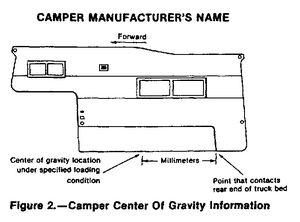
(e) A picture showing the location of the longitudinal center of
gravity of the camper within an accuracy of 50 millimeters under the
loaded condition specified in paragraph S5.1.1(d), in the manner
illustrated in Figure 2. Until October 1, 1973, the phrase ``Mount at
Aft End of Truck Cargo Area'' may be used in Figure 2 instead of
``Point That Contacts Rear End of Truck Bed.''
* * * * * *
14. Section 571.126 would be amended by revising Figure 1 at the
end of the introductory paragraph in S5.1.1 to read as follows:
MFD. BY: (CAMPER MANUFACTURER'S NAME)
(MONTH AND YEAR OF MANUFACTURE)
THIS CAMPER CONFORMS TO ALL APPLICABLE FEDERAL MOTOR VEHICLE SAFETY
STANDARDS IN EFFECT ON THE DATE OF MANUFACTURE SHOWN ABOVE
CAMPER WEIGHT IS ____KG (____LBS.) MAXIMUM WHEN IT CONTAINS STANDARD
EQUIPMENT, ____LTRS. (____GAL.) OF WATER, ____KG. (____LBS.) OF
BOTTLED GAS, AND ____ CUBIC METERS (____ CUBIC FT.) REFRIGERATOR (OR
ICEBOX WITH ____KG (____LBS.) OF ICE, AS APPLICABLE). CONSULT
OWNER'S MANUAL (OR DATA SHEET AS APPLICABLE) FOR WEIGHTS OF
ADDITIONAL OR OPTIONAL EQUIPMENT.
(VEHICLE IDENTIFICATION NUMBER)
Figure 1. Label for Campers
15. In Sec. 571.126, Figure 2 at S5.1.1, after the introductory
paragraph, would be revised to read as follows:
 16. Section 571.205 would be amended by revising in S5.1.1.2,
paragraph (m); revising S5.1.1.5; revising in S5.1.2.2, paragraph (b);
revising in S5.1.2.3, paragraph (b); revising in S5.1.2.9, paragraph
(b); and revising in S5.1.2.10, paragraph (b), to read as follows:
Sec. 571.205 Standard No. 205, Glazing materials.
* * * * *
S5.1.1.2 * * *
(m) For Item 5 safety glazing only: Motorcycle windscreens below
the intersection of a horizontal plane 380 millimeters vertically above
the lowest seating position.
* * * * *
S5.1.1.5 The phrase ``readily removable'' windows as defined in
ANS Z26, for the purposes of this standard, in buses having a GVWR of
more than 4536 kilograms, shall include pushout windows and windows
mounted in emergency exits that can be manually pushed out of their
location in the vehicle without the use of tools, regardless of whether
such windows remain hinged at one side to the vehicle.
S5.1.2.2 * * *
(b) Motorcycle windscreens below the intersection of a horizontal
plane 380 millimeters vertically above the lowest seating position.
* * * * *
S5.1.2.3 * * *
(b) Motorcycle windscreens below the intersection of a horizontal
plane 380 millimeters vertically above the lowest seating position.
* * * * *
S5.1.2.9 * * *
(b) Glass-plastic specimens shall be exposed to an ambient air
temperature of -40 degrees Celsius (plus or minus 5 degrees Celsius),
for a period of 6 hours at the commencement of Test No. 28, rather than
at the initial temperature specified in that test. After testing, the
glass-plastic specimens shall show no evidence of cracking, clouding,
delaminating, or other evidence of deterioration.
* * * * *
S5.1.2.10 * * *
(b) Each manufacturer of glazing materials designed to meet the
requirements of paragraphs S5.1.2.4, S5.1.2.5, S5.1.2.6, S5.1.2.7, or
S5.1.2.8 may permanently and indelibly mark the lower center of each
item of such glazing material, in letters not less than 4.5 millimeters
nor more than 6 millimeters high, the following words, GLASS PLASTIC
MATERIAL--SEE OWNER'S MANUAL FOR CARE INSTRUCTIONS.
* * * * *
17. Section 571.206 would be amended by revising S4.1.1.1; revising
S4.1.1.2; revising S4.1.2; revising S4.2.1.1; revising S4.2.1.2;
revising S4.2.2; revising S4.3; and revising S5.3, to read as follows:
Sec. 571.206 Standard No. 206, Door locks and door retention
components.
* * * * *
S4.1.1.1 Longitudinal Load. The door latch and striker assembly,
when in the fully latched position, shall not separate when a
longitudinal load of 11,120 Newtons is applied. When in the secondary
latch position, the door latch and striker assembly shall not separate
when a longitudinal load of 4,450 Newtons is applied.
S4.1.1.2 Transverse Load. The door latch and striker assembly,
when in the fully latched position, shall not separate when a
transverse load of 8,900 Newtons is applied. When in the secondary
latched position, the door latch and striker assembly shall not
separate when a transverse load of 4,450 Newtons is applied.
* * * * *
S4.1.2. Door Hinges. Each door hinge system shall support the door
and shall not separate when a longitudinal load of 11,120 Newtons is
applied. Similarly, each door hinge system shall not separate when a
transverse load of 8,900 Newtons is applied.
* * * * *
S4.2.1.1 Longitudinal Load. Each latch system, when in the latched
position, shall not separate when a longitudinal load of 11,120 Newtons
is applied.
S4.2.1.2 Transverse Load. Each latch system, when in the latched
position, shall not separate when a transverse load of 8,900 Newtons is
applied. When more than one latch system is used on a single door, the
load requirement may be divided among the total number of latch
systems.
S4.2.2 Door Hinges. Each door hinge system shall support the door
and shall not separate when a longitudinal load of 11,120 Newtons is
applied, and when a transverse load of 8,900 Newtons is applied.
S4.3 Sliding Doors. The track and slide combination or other
supporting means for each sliding door shall not separate when a total
transverse load of 17,800 Newtons is applied, with the door in the
closed position.
* * * * *
S5.3 Sliding Doors. Compliance with S4.3 shall be demonstrated by
applying an outward transverse load of 8,900 Newtons to the load
bearing members at the opposite edges of the door (17,800 Newtons
total). The demonstration may be performed either in the vehicle or
with the door retention components in a bench test fixture.
18. Section 571.207 would be amended by revising in S4.2, the
introductory paragraph, paragraph (a), paragraph (b), and paragraph
(d); revising S4.3.2.1; and revising S5.1.2, to read as follows:
Sec. 571.207 Standard No. 207, Seating systems.
* * * * *
S.4.2 General performance requirements. When tested in accordance
with S5., each occupant seat, other than a side-facing seat or a
passenger seat on a bus, shall withstand the following forces, in
Newtons.
(a) In any position to which it can be adjusted--20 times the
weight of the seat in kilograms multiplied by 9.8 applied in a forward
longitudinal direction;
(b) In any position to which it can be adjusted--20 times the
weight of the seat applied in kilograms multiplied by 9.8 in a rearward
longitudinal direction;
* * * * *
(d) In its rearmost position--a force that produces a 373 Newton
meters moment about the seating reference point for each designated
seating position that the seat provides, applied to the upper cross-
member of the seat back or the upper seat back, in a rearward
longitudinal direction for forward-facing seats and in a forward
longitudinal direction for rearward-facing seats.
* * * * *
S4.3.2.1 Static force.
(a) Once engaged, the restraining device for a forward-facing seat
shall not release or fail when a forward longitudinal force, in
Newtons, equal to 20 times the weight of the hinged or folding portion
of the seat in kilograms multiplied by 9.8 is applied through the
center of gravity of that portion of the seat.
(b) Once engaged, the restraining device for a forward-facing seat
shall not release or fail when a forward longitudinal force, in
Newtons, equal to 8 times the weight of the hinged or folding portion
of the seat in kilograms multiplied by 9.8 is applied through the
center of gravity of that portion of the seat.
* * * * *
S5.1.2 If the seat back and the seat bench are attached to the
vehicle by different attachments, attach to each component a fixture
capable of transmitting a force to that component. Apply forces, in
Newtons, equal to 20 times the weight of the seat in kilograms
multiplied by 9.8 horizontally through the center of gravity of the
seat back, as shown in Figure 2 and apply forces, in Newtons, equal to
20 times the weight of the seat in kilograms multiplied by 9.8
horizontally through the center of gravity of the seat bench, as shown
in Figure 3.
* * * * *
19. Section 571.212 would be amended by revising S3; revising S5;
revising in S6.1, paragraph (b); and revising S6.5, to read as follows:
Sec. 571.212 Standard No. 212, Windshield mounting.
* * * * *
S3. Application. This standard applies to passenger cars, and to
multipurpose passenger vehicles, trucks, and buses having a gross
vehicle weight rating of 4536 kilograms or less. However, it does not
apply to forward control vehicles, walk-in van-type vehicles, or to
open-body type vehicles with fold-down or removable windshields.
* * * * *
S5. Requirements. When the vehicle travelling longitudinally
forward at any speed up to and including 48 kilometers per hour impacts
a fixed collision barrier that is perpendicular to the line of travel
of the vehicle, under the conditions of S6, the windshield mounting of
the vehicle shall retain not less than the minimum portion of the
windshield periphery specified in S5.1 and S5.2.
S6.1 * * *
(b) Except as specified in S6.2, a multipurpose passenger vehicle,
truck or bus is loaded to its unloaded vehicle weight, plus 136
kilograms or its rated cargo and luggage capacity, whichever is less,
secured to the vehicle, plus a 50th-percentile test dummy as specified
in part 572 of this chapter at each from outboard designated seating
position and at any other position whose protection system is required
to be tested by a dummy under the provisions of Standard No. 208. Each
dummy is restrained only by means that are installed for protection at
its seating position. The load is distributed so that the weight on
each axle as measured at the tire-ground interface is in proportion to
its GAWR. If the weight on any axle when the vehicle is loaded to its
unloaded vehicle weight plus dummy weight exceeds the axle's
proportional share of the test weight, the remaining weight is placed
so that the weight on that axle remains the same. For the purposes of
this section, unloaded vehicle weight does not include the weight of
work-performing accessories. Vehicles are tested to a maximum unloaded
vehicle weight of 2.495 kilograms.
* * * * *
S6.5 The windshield mounting material and all vehicle components in
direct contact with the mounting material are at any temperature
between -93 degrees Celsius and +43 degrees Celsius.
20. Section 571.216 would be amended by revising S3; revising S4;
revising S5; revising in S6.2, paragraph (d); and revising S6.3 to read
as follows:
Sec. 571.216 Standard No. 216, Roof crush resistance--passenger cars.
* * * * *
S3. Application. This standard applies to passenger cars, and to
multipurpose passenger vehicles, trucks and buses with a GVWR of 2722
kilograms or less. However, it does not apply to--
(a) School buses;
(b) Vehicles that conform to the rollover test requirements (S5.3)
of Standard No. 208 (Sec. 571.208) by means that require no action by
vehicle occupants; or
(c) Convertibles, except for optional compliance with the standard
as an alternative to the rollover test requirements in S5.3 of Standard
No. 208.
S4. Requirements--(a) Passenger cars. A test device as described in
S5 shall not move more than 125 millimeters, measured in accordance
with S6.4, when it is used to apply a force in Newtons equal to 1\1/2\
times the unloaded vehicle weight of the vehicle, measured in kilograms
and multiplied by 9.8 or 22,240 Newtons, whichever is less, to either
side of the forward edge of a vehicle's roof in accordance with the
procedures of S6. Both the left and right front portions of the
vehicle's roof structure shall be capable of meeting the requirements,
but a particular vehicle need not meet further requirements after being
tested at one location.
(b) Multipurpose passenger vehicles, trucks and buses with a GVWR
of 2,722 kilograms or less, manufactured on or after September 1, 1994.
For multipurpose passenger vehicles, trucks and buses with a GVWR of
2,722 kilograms or less, manufactured on or after September 1, 1994, a
test device as described in S5 shall not move more than 125
millimeters, measured in accordance with S6.4, when it is used to apply
a force in Newtons equal to 1 \1/2\ times the unloaded vehicle weight
of the vehicle, measured in kilograms and multiplied by 9.8, to either
side of the forward edge of a vehicle's roof in accordance with the
procedures of S6. Both the left and right front portions of the
vehicles's roof structure shall be capable of meeting the requirements,
but a particular vehicle need not meet further requirements after being
tested at one location.
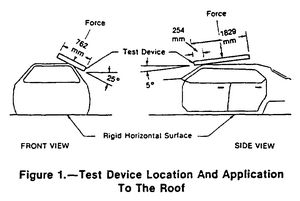
S5. Test device. The test device is a rigid unyielding block with
its lower surface formed as a flat rectangle 762 millimeters x 1829
millimeters.
* * * * *
S6.2 * * *
(d) The initial contact point, or center of the initial contact
area, is on the longitudinal centerline of the lower surface of the
test device and 254 millimeters from the forwardmost point of that
centerline.
6.3 (a) Passenger cars. Apply force in a downward direction
perpendicular to the lower surface of the test device at a rate of not
more than 13 millimeters per second until reaching a force in Newtons
of 1\1/2\ times the unloaded vehicle weight of the tested vehicle,
measured in kilograms and multiplied by 9.8 or 22,240 Newtons,
whichever is less. Complete the test within 120 seconds. Guide the test
device so that throughout the test it moves, without rotation, in a
straight line with its lower surface oriented as specified in S6.2(a)
through S6.2(d).
(b) Multipurpose passenger vehicles, trucks and buses with a GVWR
of 2,722 kilograms or less, manufactured on or after September 1, 1994.
For multipurpose passenger vehicles, trucks and buses with a GVWR of
2,722 kilograms or less, manufactured on or after September 1, 1994,
apply force in a downward direction perpendicular to the lower surface
of the test device at a rate of not more than 13 millimeters per second
until reaching a force in Newtons of 1\1/2\ times the unloaded vehicle
weight of the tested vehicle, measured in kilograms and multiplied by
9.8. Complete the test within 120 seconds. Guide the test device so
that throughout the test it moves, without rotation, in a straight line
with its lower surface oriented as specified in S6.2(a) through
S6.2(d).
* * * * *
21. Section 571.216, would be amended by revising Figure 1 at the
end of the S6.4 to read as follows:
16. Section 571.205 would be amended by revising in S5.1.1.2,
paragraph (m); revising S5.1.1.5; revising in S5.1.2.2, paragraph (b);
revising in S5.1.2.3, paragraph (b); revising in S5.1.2.9, paragraph
(b); and revising in S5.1.2.10, paragraph (b), to read as follows:
Sec. 571.205 Standard No. 205, Glazing materials.
* * * * *
S5.1.1.2 * * *
(m) For Item 5 safety glazing only: Motorcycle windscreens below
the intersection of a horizontal plane 380 millimeters vertically above
the lowest seating position.
* * * * *
S5.1.1.5 The phrase ``readily removable'' windows as defined in
ANS Z26, for the purposes of this standard, in buses having a GVWR of
more than 4536 kilograms, shall include pushout windows and windows
mounted in emergency exits that can be manually pushed out of their
location in the vehicle without the use of tools, regardless of whether
such windows remain hinged at one side to the vehicle.
S5.1.2.2 * * *
(b) Motorcycle windscreens below the intersection of a horizontal
plane 380 millimeters vertically above the lowest seating position.
* * * * *
S5.1.2.3 * * *
(b) Motorcycle windscreens below the intersection of a horizontal
plane 380 millimeters vertically above the lowest seating position.
* * * * *
S5.1.2.9 * * *
(b) Glass-plastic specimens shall be exposed to an ambient air
temperature of -40 degrees Celsius (plus or minus 5 degrees Celsius),
for a period of 6 hours at the commencement of Test No. 28, rather than
at the initial temperature specified in that test. After testing, the
glass-plastic specimens shall show no evidence of cracking, clouding,
delaminating, or other evidence of deterioration.
* * * * *
S5.1.2.10 * * *
(b) Each manufacturer of glazing materials designed to meet the
requirements of paragraphs S5.1.2.4, S5.1.2.5, S5.1.2.6, S5.1.2.7, or
S5.1.2.8 may permanently and indelibly mark the lower center of each
item of such glazing material, in letters not less than 4.5 millimeters
nor more than 6 millimeters high, the following words, GLASS PLASTIC
MATERIAL--SEE OWNER'S MANUAL FOR CARE INSTRUCTIONS.
* * * * *
17. Section 571.206 would be amended by revising S4.1.1.1; revising
S4.1.1.2; revising S4.1.2; revising S4.2.1.1; revising S4.2.1.2;
revising S4.2.2; revising S4.3; and revising S5.3, to read as follows:
Sec. 571.206 Standard No. 206, Door locks and door retention
components.
* * * * *
S4.1.1.1 Longitudinal Load. The door latch and striker assembly,
when in the fully latched position, shall not separate when a
longitudinal load of 11,120 Newtons is applied. When in the secondary
latch position, the door latch and striker assembly shall not separate
when a longitudinal load of 4,450 Newtons is applied.
S4.1.1.2 Transverse Load. The door latch and striker assembly,
when in the fully latched position, shall not separate when a
transverse load of 8,900 Newtons is applied. When in the secondary
latched position, the door latch and striker assembly shall not
separate when a transverse load of 4,450 Newtons is applied.
* * * * *
S4.1.2. Door Hinges. Each door hinge system shall support the door
and shall not separate when a longitudinal load of 11,120 Newtons is
applied. Similarly, each door hinge system shall not separate when a
transverse load of 8,900 Newtons is applied.
* * * * *
S4.2.1.1 Longitudinal Load. Each latch system, when in the latched
position, shall not separate when a longitudinal load of 11,120 Newtons
is applied.
S4.2.1.2 Transverse Load. Each latch system, when in the latched
position, shall not separate when a transverse load of 8,900 Newtons is
applied. When more than one latch system is used on a single door, the
load requirement may be divided among the total number of latch
systems.
S4.2.2 Door Hinges. Each door hinge system shall support the door
and shall not separate when a longitudinal load of 11,120 Newtons is
applied, and when a transverse load of 8,900 Newtons is applied.
S4.3 Sliding Doors. The track and slide combination or other
supporting means for each sliding door shall not separate when a total
transverse load of 17,800 Newtons is applied, with the door in the
closed position.
* * * * *
S5.3 Sliding Doors. Compliance with S4.3 shall be demonstrated by
applying an outward transverse load of 8,900 Newtons to the load
bearing members at the opposite edges of the door (17,800 Newtons
total). The demonstration may be performed either in the vehicle or
with the door retention components in a bench test fixture.
18. Section 571.207 would be amended by revising in S4.2, the
introductory paragraph, paragraph (a), paragraph (b), and paragraph
(d); revising S4.3.2.1; and revising S5.1.2, to read as follows:
Sec. 571.207 Standard No. 207, Seating systems.
* * * * *
S.4.2 General performance requirements. When tested in accordance
with S5., each occupant seat, other than a side-facing seat or a
passenger seat on a bus, shall withstand the following forces, in
Newtons.
(a) In any position to which it can be adjusted--20 times the
weight of the seat in kilograms multiplied by 9.8 applied in a forward
longitudinal direction;
(b) In any position to which it can be adjusted--20 times the
weight of the seat applied in kilograms multiplied by 9.8 in a rearward
longitudinal direction;
* * * * *
(d) In its rearmost position--a force that produces a 373 Newton
meters moment about the seating reference point for each designated
seating position that the seat provides, applied to the upper cross-
member of the seat back or the upper seat back, in a rearward
longitudinal direction for forward-facing seats and in a forward
longitudinal direction for rearward-facing seats.
* * * * *
S4.3.2.1 Static force.
(a) Once engaged, the restraining device for a forward-facing seat
shall not release or fail when a forward longitudinal force, in
Newtons, equal to 20 times the weight of the hinged or folding portion
of the seat in kilograms multiplied by 9.8 is applied through the
center of gravity of that portion of the seat.
(b) Once engaged, the restraining device for a forward-facing seat
shall not release or fail when a forward longitudinal force, in
Newtons, equal to 8 times the weight of the hinged or folding portion
of the seat in kilograms multiplied by 9.8 is applied through the
center of gravity of that portion of the seat.
* * * * *
S5.1.2 If the seat back and the seat bench are attached to the
vehicle by different attachments, attach to each component a fixture
capable of transmitting a force to that component. Apply forces, in
Newtons, equal to 20 times the weight of the seat in kilograms
multiplied by 9.8 horizontally through the center of gravity of the
seat back, as shown in Figure 2 and apply forces, in Newtons, equal to
20 times the weight of the seat in kilograms multiplied by 9.8
horizontally through the center of gravity of the seat bench, as shown
in Figure 3.
* * * * *
19. Section 571.212 would be amended by revising S3; revising S5;
revising in S6.1, paragraph (b); and revising S6.5, to read as follows:
Sec. 571.212 Standard No. 212, Windshield mounting.
* * * * *
S3. Application. This standard applies to passenger cars, and to
multipurpose passenger vehicles, trucks, and buses having a gross
vehicle weight rating of 4536 kilograms or less. However, it does not
apply to forward control vehicles, walk-in van-type vehicles, or to
open-body type vehicles with fold-down or removable windshields.
* * * * *
S5. Requirements. When the vehicle travelling longitudinally
forward at any speed up to and including 48 kilometers per hour impacts
a fixed collision barrier that is perpendicular to the line of travel
of the vehicle, under the conditions of S6, the windshield mounting of
the vehicle shall retain not less than the minimum portion of the
windshield periphery specified in S5.1 and S5.2.
S6.1 * * *
(b) Except as specified in S6.2, a multipurpose passenger vehicle,
truck or bus is loaded to its unloaded vehicle weight, plus 136
kilograms or its rated cargo and luggage capacity, whichever is less,
secured to the vehicle, plus a 50th-percentile test dummy as specified
in part 572 of this chapter at each from outboard designated seating
position and at any other position whose protection system is required
to be tested by a dummy under the provisions of Standard No. 208. Each
dummy is restrained only by means that are installed for protection at
its seating position. The load is distributed so that the weight on
each axle as measured at the tire-ground interface is in proportion to
its GAWR. If the weight on any axle when the vehicle is loaded to its
unloaded vehicle weight plus dummy weight exceeds the axle's
proportional share of the test weight, the remaining weight is placed
so that the weight on that axle remains the same. For the purposes of
this section, unloaded vehicle weight does not include the weight of
work-performing accessories. Vehicles are tested to a maximum unloaded
vehicle weight of 2.495 kilograms.
* * * * *
S6.5 The windshield mounting material and all vehicle components in
direct contact with the mounting material are at any temperature
between -93 degrees Celsius and +43 degrees Celsius.
20. Section 571.216 would be amended by revising S3; revising S4;
revising S5; revising in S6.2, paragraph (d); and revising S6.3 to read
as follows:
Sec. 571.216 Standard No. 216, Roof crush resistance--passenger cars.
* * * * *
S3. Application. This standard applies to passenger cars, and to
multipurpose passenger vehicles, trucks and buses with a GVWR of 2722
kilograms or less. However, it does not apply to--
(a) School buses;
(b) Vehicles that conform to the rollover test requirements (S5.3)
of Standard No. 208 (Sec. 571.208) by means that require no action by
vehicle occupants; or
(c) Convertibles, except for optional compliance with the standard
as an alternative to the rollover test requirements in S5.3 of Standard
No. 208.
S4. Requirements--(a) Passenger cars. A test device as described in
S5 shall not move more than 125 millimeters, measured in accordance
with S6.4, when it is used to apply a force in Newtons equal to 1\1/2\
times the unloaded vehicle weight of the vehicle, measured in kilograms
and multiplied by 9.8 or 22,240 Newtons, whichever is less, to either
side of the forward edge of a vehicle's roof in accordance with the
procedures of S6. Both the left and right front portions of the
vehicle's roof structure shall be capable of meeting the requirements,
but a particular vehicle need not meet further requirements after being
tested at one location.
(b) Multipurpose passenger vehicles, trucks and buses with a GVWR
of 2,722 kilograms or less, manufactured on or after September 1, 1994.
For multipurpose passenger vehicles, trucks and buses with a GVWR of
2,722 kilograms or less, manufactured on or after September 1, 1994, a
test device as described in S5 shall not move more than 125
millimeters, measured in accordance with S6.4, when it is used to apply
a force in Newtons equal to 1 \1/2\ times the unloaded vehicle weight
of the vehicle, measured in kilograms and multiplied by 9.8, to either
side of the forward edge of a vehicle's roof in accordance with the
procedures of S6. Both the left and right front portions of the
vehicles's roof structure shall be capable of meeting the requirements,
but a particular vehicle need not meet further requirements after being
tested at one location.
S5. Test device. The test device is a rigid unyielding block with
its lower surface formed as a flat rectangle 762 millimeters x 1829
millimeters.
* * * * *
S6.2 * * *
(d) The initial contact point, or center of the initial contact
area, is on the longitudinal centerline of the lower surface of the
test device and 254 millimeters from the forwardmost point of that
centerline.
6.3 (a) Passenger cars. Apply force in a downward direction
perpendicular to the lower surface of the test device at a rate of not
more than 13 millimeters per second until reaching a force in Newtons
of 1\1/2\ times the unloaded vehicle weight of the tested vehicle,
measured in kilograms and multiplied by 9.8 or 22,240 Newtons,
whichever is less. Complete the test within 120 seconds. Guide the test
device so that throughout the test it moves, without rotation, in a
straight line with its lower surface oriented as specified in S6.2(a)
through S6.2(d).
(b) Multipurpose passenger vehicles, trucks and buses with a GVWR
of 2,722 kilograms or less, manufactured on or after September 1, 1994.
For multipurpose passenger vehicles, trucks and buses with a GVWR of
2,722 kilograms or less, manufactured on or after September 1, 1994,
apply force in a downward direction perpendicular to the lower surface
of the test device at a rate of not more than 13 millimeters per second
until reaching a force in Newtons of 1\1/2\ times the unloaded vehicle
weight of the tested vehicle, measured in kilograms and multiplied by
9.8. Complete the test within 120 seconds. Guide the test device so
that throughout the test it moves, without rotation, in a straight line
with its lower surface oriented as specified in S6.2(a) through
S6.2(d).
* * * * *
21. Section 571.216, would be amended by revising Figure 1 at the
end of the S6.4 to read as follows:
 Issued on: March 4, 1994.
Barry Felrice,
Associate Administrator for Rulemaking.
[FR Doc. 94-5486 Filed 3-14-94; 8:45 am]
BILLING CODE 4910-59-M
[Federal Register Volume 59, Number 55 (Tuesday, March 22, 1994)]
[Unknown Section]
[Page 0]
From the Federal Register Online via the Government Printing Office [www.gpo.gov]
[FR Doc No: X94-40322]
[[Page Unknown]]
[Federal Register: March 22, 1994]
-----------------------------------------------------------------------
DEPARTMENT OF TRANSPORTATION
National Highway Traffic Safety Administration
49 CFR Part 571
[Docket No. 93-87; Notice 1]
RIN 2127-AF03
Federal Motor Vehicle Safety Standards; Metric Conversion
Correction
In proposed rule document 94-5486 beginning on page 11962, in the
issue of Tuesday, March 15, 1994, make the following corrections:
Sec. 571.120 [Corrected]
1.On page 11967, in the second column, in Sec. 571.120, in
paragraph S5.3.2 Rim, under the heading Truck Example and subheading
SUITABLE TIRE-RIM CHOICE, in the seventh line, ``with 7.50---29-(D)
tires,'' should read ``with 7.50---20-(D) tires,''.
2.On page 11968, in the 1st column, in Sec. 571.120, in paragraph
S5.1.1 Labels., in the 11th line, ``or'' should read ``of''.
3.On the same page, in the same column, in Sec. 571.120 (d), in the
eighth line,`` (------ Ft.)'' should read ``(------ Cubic Ft.)''.
Sec. 571.207 [Corrected]
4.On page 11969, in the third column, in Sec. 571.207 (b), in the
eighth line, ``from'' should read ``front''; and in the second line
from the bottom, ``2.495'' should read ``2,495''.
BILLING CODE 1505-01-D
Issued on: March 4, 1994.
Barry Felrice,
Associate Administrator for Rulemaking.
[FR Doc. 94-5486 Filed 3-14-94; 8:45 am]
BILLING CODE 4910-59-M
[Federal Register Volume 59, Number 55 (Tuesday, March 22, 1994)]
[Unknown Section]
[Page 0]
From the Federal Register Online via the Government Printing Office [www.gpo.gov]
[FR Doc No: X94-40322]
[[Page Unknown]]
[Federal Register: March 22, 1994]
-----------------------------------------------------------------------
DEPARTMENT OF TRANSPORTATION
National Highway Traffic Safety Administration
49 CFR Part 571
[Docket No. 93-87; Notice 1]
RIN 2127-AF03
Federal Motor Vehicle Safety Standards; Metric Conversion
Correction
In proposed rule document 94-5486 beginning on page 11962, in the
issue of Tuesday, March 15, 1994, make the following corrections:
Sec. 571.120 [Corrected]
1.On page 11967, in the second column, in Sec. 571.120, in
paragraph S5.3.2 Rim, under the heading Truck Example and subheading
SUITABLE TIRE-RIM CHOICE, in the seventh line, ``with 7.50---29-(D)
tires,'' should read ``with 7.50---20-(D) tires,''.
2.On page 11968, in the 1st column, in Sec. 571.120, in paragraph
S5.1.1 Labels., in the 11th line, ``or'' should read ``of''.
3.On the same page, in the same column, in Sec. 571.120 (d), in the
eighth line,`` (------ Ft.)'' should read ``(------ Cubic Ft.)''.
Sec. 571.207 [Corrected]
4.On page 11969, in the third column, in Sec. 571.207 (b), in the
eighth line, ``from'' should read ``front''; and in the second line
from the bottom, ``2.495'' should read ``2,495''.
BILLING CODE 1505-01-D