















Federal Motor Vehicle Safety Standards; Child Restraint Systems |
|---|
 Topics: National Highway Traffic Safety Administration
|
Barry Felrice
Federal Register
March 16, 1994
[Federal Register: March 16, 1994]
=======================================================================
-----------------------------------------------------------------------
DEPARTMENT OF TRANSPORTATION
National Highway Traffic Safety Administration
49 CFR Part 571
[Docket No. 74-09; Notice 35]
RIN 2127-AF02
Federal Motor Vehicle Safety Standards; Child Restraint Systems
AGENCY: National Highway Traffic Safety Administration (NHTSA),
Department of Transportation.
ACTION: Notice of proposed rulemaking (NPRM).
-----------------------------------------------------------------------
SUMMARY: This document addresses the possible need to add a greater
array of test dummies to Standard 213 for use in compliance tests. It
is the second of two proposals on child booster seat safety resulting
from the Intermodal Surface Transportation Efficiency Act of 1991. That
Act directed NHTSA to initiate rulemaking on child booster seat safety.
The first NPRM proposed to amend Standard 213's requirements for child
booster seats designed for use with a vehicle's lap and shoulder belts.
Today's NPRM is intended to improve the safety of booster seats and
other types of child restraint systems by providing for their more
thorough compliance testing.
DATES: Comments on this document must be received by the agency no
later than May 16, 1994. The proposed effective date is 180 days after
the date of publication of a final rule.
ADDRESSES: Comments should refer to the docket number and notice number
and be submitted in writing to: Docket Section, National Highway
Traffic Safety Administration, room 5109, 400 Seventh Street, SW.,
Washington, DC, 20590. Telephone: (202) 366-5267. Docket hours are 9:30
a.m. to 4 p.m. Monday through Friday.
FOR FURTHER INFORMATION CONTACT:
Dr. George Mouchahoir, Office of Vehicle Safety Standards, National
Highway Traffic Safety Administration, 400 Seventh St., SW.,
Washington, DC, 20590 (telephone 202-366-4919).
SUPPLEMENTARY INFORMATION:
Table of Contents
I. Introduction.
a. Purpose of this NPRM.
b. Previous NPRM.
II. Specific proposals.
a. Child dummies.
1. Dummy selection based on recommended weight of child
restraint users.
2. Dummy selection based on recommended sitting height of child
restraint users.
b. Performance criteria.
c. Clarifying amendments.
d. Other issues.
III. Rulemaking Analyses and Notices.
a. Executive Order 12866 and DOT Regulatory Policies and
Procedures.
b. Regulatory Flexibility Act.
c. Executive Order 12612.
d. National Environmental Policy Act.
e. Executive Order 12778.
IV. Comments on the proposal.
I. Introduction
This document follows an advance notice of proposed rulemaking
(ANPRM) published on May 29, 1992 about child booster seat safety (57
FR 22682). The ANPRM was issued in response to the National Highway
Traffic Safety Administration Authorization Act of 1991 (sections 2500-
2509 of the Intermodal Surface Transportation Efficiency Act
(``ISTEA'')). That Act directed the agency to initiate rulemaking on
child booster seat safety and other issues.
The legislative history of the ISTEA directive on booster seats
sheds light on the source of Congress's concerns about booster seats.
That history, and Congress's concerns, were discussed in detail in the
May 1992 ANPRM, and are briefly summarized below.
The ISTEA directive originated in S. 1012, a bill reported by the
Senate Committee on Commerce, Science, and Transportation and added
verbatim to the Senate's surface transportation bill (S. 1204). The
Senate Commerce Committee report on S. 1012 expressed concern about
suggestions that booster seats, ``depending on their design, can be
easily misused or are otherwise harmful,'' and that some child seat
boosters ``may not restrain adequately a child in a crash.''
The committee's concerns about the possible inability of a booster
seat to restrain some children adequately stemmed from a study\1\
performed by Calspan Corporation. Calspan found that when the then-
manufactured booster seats were tested with test dummies representing
the range of children for whom the seats were recommended, the booster
seats did not appear to be able to adequately restrain all of those
test dummies. When tested to the requirements of Standard 213, however,
the booster seat passed the requirements because the standard specifies
the use of only one dummy, a dummy representing a 3-year-old (33 pound)
child, for testing a booster seat. (See S7.2 of Standard 213.) The
implication of these test results was that test dummies representative
of a wide range of child sizes were needed in Standard 213 to more
effectively test the performance of booster seats and other child
restraint systems. What seemed especially needed was an array of
dummies representing children at or near the extremes of the weight
ranges identified by a manufacturer as being suitable for any type of
child restraint.
---------------------------------------------------------------------------
\1\``Evaluation of the Performance of Child Restraint Systems''
(DOT HS 807 297, May 1988).
---------------------------------------------------------------------------
a. Purpose of Today's NPRM
This document proposes to add additional sizes of child compliance
test dummies to Standard 213, consistent with ISTEA's mandate and the
potential safety problems shown in the Calspan study. NHTSA's efforts
to address those safety problems, including the possibility of new test
dummies, were begun prior to ISTEA. Amending Standard 213 to
incorporate additional test dummies for use in compliance tests has
been one of NHTSA's main initiatives for upgrading Standard 213, as
stated in NHTSA's ``Planning Document on the Potential Standard 213
Upgrade,'' July 1991 (docket 74-09-N21). To that end, NHTSA developed
specifications for three new test dummies and completed rulemaking in
1991 and 1993 incorporating those specifications into part 572, the
agency's regulation on anthropomorphic test dummies. This step
facilitated the use of those dummies in the development of improved
child restraints.
Today's document, together with a companion NPRM published on
September 1, 1993 (discussed in the next section), responds to ISTEA as
well as follows up on the agency's 1991 planning document regarding
possible ways of upgrading Standard 213. As explained in the ``Other
Issues'' section of this document, some of the ways of upgrading
Standard 213 will be addressed over the course of several rulemakings.
As to the other ways, some are being further evaluated; the remaining
ones do not appear viable candidates for rulemaking. The agency notes
that, in accordance with its plan to convert to the metric system
pursuant to the Omnibus Trade and Competiveness Act and E.O. 12770,
today's proposal uses metric units. Thus, English units that are in
sections of Standard 213 affected by this NPRM would be converted to
metric units. For example, ``nine kilograms (kg)'' would replace
references in the standard to ``20 pounds.''
b. Previous NPRM
The companion NPRM to this document was published on September 3,
1993 (58 FR 46928). The NPRM, which also resulted from the May 1992
ANPRM, proposed to amend Standard 213 to permit the manufacturer and
sale of belt-positioning booster child seats (child seat boosters
designed for use with a vehicle's lap/shoulder belt system). NHTSA said
it believes that facilitating the manufacture of belt-positioning
booster seat could improve booster seat safety because belt-positioning
seats appear to be capable of accommodating a wider range of child
sizes than currently manufactured shield-type boosters. Also, NHTSA
stated that it believes there is a possibility that belt-positioning
booster seats used with vehicle lap/shoulder belts would perform better
than shield booster seats. NHTSA proposed amending Standard 213's
compliance test procedures to specify that belt-positioning booster
seats would be dynamically tested when restrained to the test apparatus
with a lap/shoulder belt. NHTSA also proposed labeling and
informational requirements to decrease the possibility that booster
seats would be misused.
II. Specific Proposals in Today's NPRM
a. Child Dummies
Three new child dummies have been tentatively selected to be added
to Standard 213 for use in the compliance testing of child
restraints.These dummies are the newborn infant dummy described in
subpart K of 49 CFR part 572, the 9-month-old dummy in subpart J, and
the instrumented 6-year-old dummy in subpart I. The biofidelity,
reliability and repeatability of the test dummies were discussed in the
documents incorporating the dummies into part 572 for the purpose of
facilitating child restraint development. See, final rule for newborn
dummy (January 8, 1993, 58 FR 3229); 9-month-old dummy (August 19,
1991; 56 FR 41077); 6-year-old dummy (November 14, 1991; 56 FR 57830).
This document proposes detailed descriptions of the clothing,
conditioning and positioning procedures for the dummies to ensure that
the test conditions are carefully controlled. The clothing that would
be specified is the same, except for size, as that used for the 3-year-
old dummy. The conditioning specifications are the same as those
currently used for the 3-year-old dummy.
With the addition of the three new dummies, there would be four
child test dummies used for Standard 213 compliance testing. The fourth
dummy would be the existing 3-year-old dummy (subpart C) for Standard
213 testing. As to the other existing dummy, the 6-month-old, 17 pound
(8 kg) dummy (subpart D), the agency has tentatively decided that it
would no longer use that dummy to test child restraints. The agency has
tentatively decided that testing child restraints with that dummy is
unnecessary since the newborn and 9-month-old dummies appear sufficient
to evaluate the performance of a child restraint recommended for
infants. Comments are requested on whether the 6-month-old, subpart D
dummy would still be needed to test child restraints, and if so, which
restraints should be tested with that dummy.
In its comment on the ANPRM, General Motors (GM) expressed concern
about the 6-year-old and the 3-year-old dummies. GM asked NHTSA to
refer to GM's comments on the agency's earlier rulemaking proposals to
incorporate these dummies in part 572 to aid in child restraint
development. According to GM, those comments ``detail (GM's) concerns
regarding limitations of these test devices * * * .'' While the comment
is unclear as to what GM means by ``limitations,'' NHTSA assumes the
commenter is referring to the biofidelity and suitability of the
dummies as test devices, or the ability of the dummies to measure
various crash forces imposed on them. NHTSA responded to issues about
the biofidelity and suitability of the dummies in the previous
rulemakings on part 572. The agency is not aware of any information,
submitted by GM or arising elsewhere, indicating that these dummies
have ``limitations'' warranting their exclusion from use in Standard
213 testing. Moreover, information on the performance of the dummies in
tests conducted subsequent to their incorporation into part 572 does
not indicate any problems with their performance. Recently, these
dummies were used along with the part 572 three-year-old in a large
number of sled tests that NHTSA conducted as part of its child safety
research program that was described in the agency's 1991 planning
document to upgrade Standard 213. These dummies appeared to perform
satisfactorily, without any problem that would prevent their
incorporation into FMVSS 213. The findings of this research program
were summarized in a series of reports that were published in October
1992, under project VRTC-82-0236 ``Child Restraint Testing (Rulemaking
Support).'' These reports are available from the National Technical
Information Service, Springfield, Virginia, 22161.
GM suggested in its ANPRM comments that the child test dummies
should provide a ``more complete set of measurements'' than currently
provided by the three-year-old dummy. GM suggested including the
additional measurement of forces imposed on the dummy's neck, abdomen,
and femur areas. GM stated that injuries to children's neck, abdomen,
and hip, thigh and knee areas can be serious, and that performance
criteria for these injuries should be developed. GM said that these
criteria can be measured and the neck and femur load cells are
currently available for most child dummies. The commenter also said
that the development of a device to measure abdominal injury is both
possible and essential.
NHTSA responded to an identical comment from GM on this issue in
the rulemaking adopting the 6-year-old dummy specifications into part
572. The part 572 6-year-old dummy, referred to as SA106C, can provide
measurements of crash forces imposed on the dummy's femurs, in addition
to measurements of head and chest accelerations. In the rulemaking
adopting the SA106C dummy (the same dummy being considered today) into
part 572, GM suggested that NHTSA adopt a 6-year-old dummy based on the
50th percentile male Hybrid-III dummy instead of the SA106C 6-year-old
dummy, because the Hybrid-III child dummy was superior in its
instrumentation.
NHTSA responded: Ford and GM might be correct that the Hybrid-III
type 6-year-old dummy (which has yet to be completed and evaluated)
might eventually have potential advantages over the NHTSA/Humanoid
dummy in the number of parameters the dummies can measure. However,
NHTSA does not believe that this rulemaking should be delayed to
further consider the potential advantages of future dummies. The SA106C
dummy's ability to measure HIC, chest acceleration and femur loads, and
its ability to replicate the motions and excursions of a child in a
crash are sufficient to provide valid assessment of the injury
potential of child restraint systems in a reliable manner. Since the
SA106C dummy is ready now, and a final rule specifying the dummy will
help improve safety, the agency believes it is appropriate to proceed
with adding the dummy to part 572. NHTSA intends to evaluate the
Hybrid-III type 6-year-old dummy after the dummy's design and
development are completed and the dummy is commercially available.
NHTSA is not aware of any information showing that an alternate
child test dummy, such as the Hybrid-III 6-year-old dummy, instead of
the part 572 dummy, should be incorporated into Standard 213.
Accordingly, NHTSA has decided to proceed with this proposal to
incorporate the part 572 6-year-old dummy.
1. Dummy Selection Based on Recommended Weight of Restraint Users
NHTSA proposes amending the provisions is S7 of Standard 213 that
specify the child dummy or dummies to be used in testing a particular
child restraint system. Currently, S7 specifies that the 6-month-old
dummy is used for testing a child restraint system that is recommended
by its manufacturer for children weighing up to 20 pounds, and the 3-
year-old dummy is used for testing a child restraint that is
recommended for children weighing more than 20 pounds. If a child
restraint system is recommended for use by children in a weight range
that includes some children below 20 pounds and others above 20 pounds,
the both dummies are to be used.
The ANPRM discussed how the agency might determine which new test
dummies might be used under Standard 213 in the compliance testing of a
particular child restraint system: S7.2 of the standard could be
amended in the following manner. A restraint that is recommended for
use by children in a weight range that includes children weighing not
more than 7.5 pounds would be tested with the newborn dummy; from 7.5
to 20 pounds, with both the newborn and the nine-month-old dummy; from
20 to 33 pounds, with both the nine-month-old and three-year-old dummy;
from 33 to 40 pounds, with the three-year-old dummy; and 40 pounds and
above, with the six-year-old dummy. The agency anticipates proposing
these, or similar, weight ranges in the near future.
The commenters generally supported using the newborn, 9-month-old,
3-year-old and 6-year-old dummies for Standard 213 compliance testing.
Gerry, Cosco, Century Products and New York State supported using the
3-year-old and 6-year-old dummies to test booster seats recommended for
children weighing more than 35 pounds.
However, commenters also had suggestions for revising the weight
ranges discussed in the ANPRM. Advocates believed that the weight
ranges were deficient because only two of the ranges (7.5 to 20 pounds
and 20 to 33 pounds) would have two test dummies, one for the lower
weight limit and another for the upper weight limit. SafetyBeltSafe
believed the 3-year-old (33 pound) dummy should be used to test booster
seats recommended for children weighing more than 40 pounds, to address
the possibility that parents might ``rush'' a child into a booster seat
when a second child needs to use the toddler restraint. Cosco believed
that any child seat recommended for children weighing over 40 pounds
should be tested with both the 3-year-old and the 6-year-old dummies,
so that dummies at the extreme weight ranges are used.
NHTSA generally agrees with these comments. The agency proposes to
amend the weight specifications in S7 of Standard 213 so that to the
extent possible, each child restraint system would be subject to being
tested using at least two test dummies. To ensure that all children
recommended for a restraint are adequately restrained, the dummies used
to test a restraint would represent a wide range of child sizes.
However, NHTSA has not proposed to combine the 20 to 33 pound and
the 33 to 40 pound ranges into a 20 to 40 pound range, as Cosco
suggested. Cosco stated that it believes that the weight ranges should
be combined so that child restraints in the 20 to 40 pound range are
tested with the 9-month-old and 3-year-old dummies. NHTSA has
tentatively determined that booster seats (typically recommended for
children 30 pounds and above) need not be tested with the 9-month-old
(20 pound) dummy. This is because the September 1993 NPRM on child
booster seat safety included a proposal that booster seats must be
labeled for children weighing not less than 30 pounds. If that proposal
is adopted, the label would likely reduce the chances that a booster
seat would be used with children weighing in the 20 pound range.
Comments are requested on this issue.
NHTSA proposes the following provisions for determining which dummy
or dummies are to be used for testing child restraints, based on child
mass:
A child restraint that is recommended by its manufacturer
for children in a specified weight range that includes any children
having a mass less than 4 kilograms (i.e., 9 pounds or less) is tested
with a newborn test dummy conforming to part 572 subpart K.
A child restraint that is recommended for children in a
specified weight range that includes any children having masses from 4
to not more than 9 kilograms (weights of 9 to 20 pounds) is tested with
a newborn test dummy and a 9-month-old test dummy conforming to part
572 subpart J.
A child restraint that is recommended for children in a
specified weight range that includes any children having masses from 9
to not more than 13.5 kilograms (weights of 20 to 30 pounds) is tested
with a 9-month-old test dummy and a 3-year-old test dummy conforming to
part 572 subpart C.
A child restraint that is recommended for children in a
specified weight range that includes any children having masses equal
to or greater than 13.5 kilograms (30 pounds and above) is tested with
a 3-year-old test dummy and a 6-year-old test dummy conforming to part
572 subpart I.
If a child restraint is recommended for a weight range of children
that overlaps, in whole or in part, two or more of the weight ranges
set out above, the restraint would be tested with the dummies specified
for each of those ranges. Thus, for example, if a child restraint were
recommended for children having masses greater than 13 kilograms, it
would be tested with the 9-month-old dummy, the 3-year-old dummy and
the 6-year-old dummy.
2. Dummy Selection Based on Recommended Sitting Height of Restraint
Users
The fundamental purpose of today's proposal is to ensure that each
child restraint performs as intended in restraining the range of
children recommended for it. Thus, in addition to the above
specifications for selecting test dummies based on recommended weight
ranges, the agency proposes to supplement those specifications with
provisions for selecting test dummies based on recommended sitting
height ranges. More specifically, NHTSA would establish supplementary
provisions specifying the use of a particular test dummy based on the
child restraint manufacturer's recommendations regarding the sitting
height of the children for whom the restraint is intended. The effect
of those provisions might in some cases be to increase the number and
variety of dummies with which a child restraint would otherwise have
been tested based solely on the manufacturer's recommendations
regarding the weight of children for whom it's restraint is suitable.
Since the Standard currently requires manufacturers to provide
recommendations concerning (standing) height, this document proposes to
change the Standard to require recommendations regarding sitting height
instead of standing height. The sitting height of a seated child is
measured from the seating surface to the top of the child's head.
Comments are requested on the merits of using a sitting height
criterion.
This issue relating to the height of the restrained child was
addressed by some commenters. Advocates commented that ``. . . child
restraints must be compliance tested for specific ranges of child
occupant sizes that appropriately match the restraint use
recommendations to the size, weight, and height, of the intended child
occupants.'' Cosco stated that as children get older, it is the height,
instead of the weight, that becomes more of a determining factor in
correct car seat use.
The agency tentatively agrees that a manufacturer's recommendations
about the suitability of the restraint for children of a particular
height should be a factor in determining the size of the dummy or
dummies to be used to test the restraint. NHTSA is concerned that if
height were not a factor, it might be possible for a restraint to be
tested with a dummy or dummies insufficiently representative of the
range of children recommended for the restraint. This could occur if a
manufacturer were to recommend inconsistent mass and height ranges. A
manufacturer could create an inconsistency by recommending a height
range that corresponds to children who are of greater mass (weight)
than the masses expressly recommended by the manufacturer for the
restraint.
For instance, suppose an infant restraint were recommended for
children with masses not more than 4 kilograms (approximately 9 pounds)
and a sitting height of up to 475 mm. Although the use of both the
newborn and 9-month-old dummies would be more representative of the
users of the restraint, only the newborn dummy would be used if dummy
selection were based solely on the mass recommendation. However,
according to a report by the University of Michigan on ``Physical
Characteristics of Children as Related to Death and Injury for Consumer
Product Safety Design,'' Report No. PB-242-221, of children with masses
of 4 kilograms, those in the 95th percentile have a sitting height of
approximately 450 mm. Since the restraint is recommended for children
with heights greater than the 95th percentile child, NHTSA has
tentatively determined that it would be appropriate to test the infant
restraint not only with the infant dummy, but also with a test dummy
representative of a taller child (i.e., with the 9-month-old dummy).
NHTSA proposes the following provisions for determining which dummy
or dummies to use for testing child restraints, based on child sitting
height.
A child restraint that is recommended for children in a
specified sitting height range that includes any children whose sitting
height is not more than 450 mm (450 mm is approximately the sitting
height for a 95th percentile newborn male child), is tested with a
newborn test dummy conforming to part 572, subpart K.
A child restraint that is recommended for children in a
specified sitting height range that includes any children whose sitting
height is between 451 mm and 500 mm (500 mm is approximately the
sitting height for a 95th percentile nine-month-old male child whose
mass is 9 kilograms), is tested with a newborn test dummy and a 9-
month-old test dummy conforming to part 572, subpart J.
A child restraint that is recommended for children in a
specified sitting height range that includes any children whose sitting
height is between 501 mm and 600 mm (600 mm is approximately the
sitting height for a 95th percentile three-year-old male child whose
mass is 13.5 kilograms), is tested with a 9-month-old test dummy and a
3-year-old test dummy conforming to part 572, subpart C.
A child restraint that is recommended for children in a
specified sitting height range that includes any children whose sitting
height is equal to or greater than 600 mm is tested with a 3-year-old
test dummy and a 6-year-old test dummy conforming to part 572, subpart
I.
If a child restraint is recommended for a sitting height range of
children that overlaps, in whole or in part, two or more of the height
ranges set out above, the restraint would be tested with the dummies
specified for each of those ranges. Thus, for example, if a child
restraint were recommended for children having sitting heights greater
than 480 mm, it would be tested with the 9-month-old dummy, the 3-year-
old dummy and the 6-year-old dummy.
b. Performance Criteria
The performance criteria which a child restraint must meet when
restraining a dummy would generally be unchanged, except as described
later in this section. Thus, the requirements regarding dynamic
performance (including the head and chest injury criteria and
excursion), force distribution, installation, child restraint belts and
buckles and flammability would generally be uniform for all restraints,
regardless of the size of the dummy used. For example, Standard 213
currently requires a child restraint to limit forces on the head and
chest of the 3-year-old test dummy, to 1000 HIC (head) and 60 g's
(chest). These criteria would be unchanged for testing done with the 6-
year-old dummy.
GM commented on the general appropriateness of the existing injury
criteria for children. The HIC and chest g's injury criteria are the
same as those specified in Standard 208, Occupant Crash Protection (49
CFR 571.208) for motor vehicles when they are tested with the 50th
percentile adult male dummy. GM stated that it believes the values for
the child dummies should be separately scaled from the adult dummy ``to
reflect anatomical differences and differing injury tolerance of
children.''
NHTSA does not agree. As to specifying different HIC values for
each child dummy, the agency does not believe that a consensus exists
on values for such limits. No person commenting on the agency's
rulemaking proposals for child restraint systems, or otherwise
providing information to the agency, has been able to provide actual
data on head injury of children of various ages to support any
suggested value for HIC other than 1000 HIC. Moreover, comments on
NHTSA's planning document agreed that the limits of 1000 HIC and 60g
chest are acceptable for the three- and six-year-old dummies. The
commenters believed that those limits are not appropriate for smaller
sized dummies, which is an issue not addressed by this NPRM. Based on
this information, NHTSA is proposing to use the 1000 HIC and 60g chest
acceleration limits of Standard 213 for the six-year-old dummy.
Some requirements in Standard 213 would differ depending on the
child test dummy used. As noted above, a child restraint might be
tested with multiple dummies under this proposal. In that event, the
largest of the dummies used in the testing would also be used for
determining the applicability of the seat back requirement and for
determining compliance with that requirement.
However, the 6-year-old dummy would not be used to determine either
whether a seat back is needed on a child restraint or whether a
required seat back is high enough although that restraint had been
tested for compliance with the dynamic performance requirements using a
6-year-old dummy. Standard 213 currently requires certain child seats
to have a seat back to provide restraint against rearward movement of
the child's head (rearward in relation to the child). (S5.2.1) The
determination of whether a seat back is required on a child restraint
is based on the dummy used in the compliance testing of the restraint.
A child restraint need not have a seat back if a specified point on the
dummy's head (approximately located at the top of the dummy's ears) is
below the top of the standard seat assembly to which the restraint is
attached for compliance testing. (S5.2.1.2) Booster seats are currently
tested with the 3-year-old dummy, which sits low enough on the standard
seat assembly that the point on the dummy's head is not above the top
of the seat assembly. Since that dummy is used, booster seats need not
have seat backs. If the 6-year-old dummy were to be incorporated into
Standard 213 and if S5.2.1 were to remain unchanged, the impact on
booster seats could be substantial. Most, if not all, booster seats
(and perhaps other types of child seats) might have to be redesigned to
have a seat back. This is because the sitting height of the 6-year-old
dummy is higher than that of the 3-year-old. As a result, the critical
point on the head of the 6-year-old dummy is likely to be above the top
of the seat assembly. There may be additional costs associated with
such redesign.
NHTSA does not know of real world crash data that indicate a
problem with head or neck injuries in rear impact crashes. (See also,
denial of petition for rulemaking to require a special warning on child
seats addressing possible whiplash injuries due to lack of head
restraint. 56 FR 3064, January 28, 1991.) In view of the possible
redesign costs and the apparent lack of a safety need for a seat back
on boosters, NHTSA has tentatively determined that S5.2.1.1 should
provide that the 6-year-old dummy is not used to determine the
applicability of or compliance with the seat back requirements.
Comments are requested on this issue. NHTSA is particularly interested
in crash data indicating a need for a requirement for a seat back on
booster seats. Comments are also requested on any additional costs that
might result from redesigning child restraints to provide a seat back.
A requirement that currently differs accordingly to the test dummy
or dummies used in testing a child restraint, and would continue to do
so under this proposal, is that regarding post-impact buckle force
release (S5.4.3.5(b)). Currently, S5.4.3.5(b) requires each child seat
belt buckle to release when a force of not more than 16 pounds is
applied, while tension (simulating a child restrained in the child
seat) is applied to the buckle. Tension is applied because a child in
the seat could impose a load on the belt buckle which increases the
difficulty of releasing it. The test procedures for this requirement
(S6.2) specify that the applied tension is 20 pounds in the case of a
system tested with a 6-month-old dummy and 45 pounds in the case of a
system tested with a 3-year-old dummy. In both cases, the force level
is based on the heaviest children who are likely to use the restraint.
NHTSA proposes to amend S6.2 so that the tension would be 50 Newtons
when the system is tested with a newborn dummy, 90 Newtons for tests
with a 9-month-old dummy, 200 Newtons for tests with a 3-year-old
dummy, and 270 Newtons for tests with a 6-year-old dummy.
c. Clarifying Amendments
NHTSA is also proposing three clarifying amendments unrelated to
the addition of new sizes of dummies to Standard 213. Two of the
amendments would clarify the standard's excursion requirements. The
excursion requirement for built-in child restraints (S5.1.3.1(b))
prohibits the dummy's knee pivot from passing through a plane that is
specified distance ``forward of the hinge point of the specific vehicle
seat into which the system is built.'' Chrysler suggested (docket 74-
09-N24-001) that NHTSA amend the reference point because the ``hinge
point of the specific vehicle seat'' cannot be readily defined for most
vehicle seats. This is because most vehicle seats into which a built-in
child restraint is fabricated do not have hinges for their backs, or
are configured so that the hinge is not easily seen during dynamic
testing.
NHTSA is addressing this concern by proposing to reference the H-
point on the seat, which is a reference point used in S11 of Standard
208, ``Occupant Crash Protection,'' and in S4.3 of Standard 210, ``Seat
Belt Assembly Anchorages.'' The H-point of a specific vehicle seating
position is determined by using equipment and procedures specified in
the Society of Automotive Engineers (SAE) recommended practice SAE J826
(May 1987), ``Devices for Use in Defining and Measuring Vehicle Seating
Accommodation.'' The H-point is identified either during the seat's
design by means of a two-dimensional drafting template, or after the
vehicle is completely manufactured, by means of a three-dimensional
device. The H-point is located at approximately the same location as
the ``hinge point'' on a vehicle seat. However, since the H-point
already must be identified by the vehicle manufacturer for purposes of
Standards 208 and 210, it appears using the H-point for Standard 213
would be expedient.
The other clarifying amendment relates to the excursion requirement
for rear-facing child restraints (S5.1.3.2). S5.1.3.2 currently states
that ``no portion of the target point on either side of the dummy's
head'' shall pass through an area on the child restraint. The quoted
language would be revised to remove the reference to a ``portion'' of
the target point. The use of ``portion'' is incorrect since the target
point is dimensionless.
The third clarifying amendment relates to the requirement in the
standard that limits the force that may be imposed on a child from the
vehicle belt used to anchor the child seat to the vehicle (S5.4.3.2).
S5.4.3.2 currently limits the force that is imposed by ``each belt that
is part of a child restrain system and that is designed to restrain a
child using the system and to attach the system to the vehicle.'' NHTSA
proposes to also limit the force imposed by each Type 1 and the lap
portion of a Type 2 vehicle belt that is used to attach the child seat
to the vehicle. These belts, which anchor the child seat to the
vehicle, function to absorb the forces of the crash into the frame of
the vehicle. NHTSA is thus proposing that these belts not transfer
those crash forces to the occupant child.
d. Other Issues
The July 1991 planning document identified several possible ways in
which Standard 213 could be upgraded. These were incorporating the
newborn, 9-month-old and 6-year-old dummies, changing aspects of
Standard 213's test procedure (e.g., the characteristics of the seat
assembly used to test child seats and the severity of the dynamic
test); changing the injury criteria (HIC, chest g's); reducing
allowable head excursion; facilitating the manufacture of belt-
positioning child seats; and addressing the interaction of air bags and
infant seats. Since issuance of the planning document, some of these
issues have been addressed through the issuance of rulemaking notices,
such as today's NPRM and the September 1993 NPRM on belt-positioning
child seats. NHTSA has also issued an NPRM on the interaction of
airbags and infant seats (NPRM at 58 FR 19792; April 16, 1993).
All of the issues identified in the 1991 planning document as
subjects of possible rulemaking have been explored in research
projects. In some instances, research has shown that rulemaking does
not appear warranted. For example, NHTSA determined that the
configuration of today's vehicle interiors does not appear to pose a
safety need to reduce allowable head excursion. This is based on a
survey of late model vehicles that NHTSA conducted to assess vehicle
interior dimensions and the fit of the three-year-old and six-year-old
dummies, as well as on the fact that child restraints provide about 70
percent effectiveness in reducing serious injuries and fatalities when
used in today's vehicle interiors. The findings of the research were
summarized in a report titled, ``Assessment of Vehicle Interior
Dimensions and Lap/Shoulder Belt Fit,'' October 1992 (VRTC-82-0236,
``Child Restraint Testing (Rulemaking Support)''). Another example
where the agency's research has shown that rulemaking is not warranted
was research addressing whether flexibility of the back of the test
seat assembly affects that test dummy's performance during compliance
testing of shield-type booster seats. The findings of this research
were summarized in a report titled, ``Evaluation of Effects of FMVSS
213 Seat Back's Flexibility on Booster Seat Responses,'' October 1992,
(VRTC-82-0236, id.)
In other instances, more information on the issue is needed. For
instance, as mentioned in section IIb (``Performance criteria'') of
this preamble, information is generally unavailable on new, possibly
more appropriate injury criteria for children. Relatedly, new, more
sophisticated child test dummies are being developed, but more must be
known about their performance, reliability and availability as possible
Standard 213 test devices.
NHTSA also seeks to learn more about a particular type of child
restraining device that appears to be proliferating. These devices are
designed to be attached to a vehicle Type II belt system to improve the
fit of the system on children, and in some cases, on small adults. The
agency seeks information on whether Standard 213 should be applied to
these devices, and if so, which of the standard's requirements would be
appropriate for those devices.
The agency notes that the regulatory text proposed in this notice
includes language that was proposed in the September 1993 NPRM on child
booster seat safety. In some instances, comments were received on
aspects of the September 1993 NPRM that are included in today's NPRM.
For example, this notice includes text proposing specifications for the
seat belt anchorage points on the standard seat assembly used to test
belt-positioning booster seats. See proposed S6.1.1(c) of this notice.
The agency is including the text that was proposed in the earlier
notice simply to illustrate the complete appearance of the affected
section. The agency is fully aware of the issues raised by commenters
to various aspects of the September 1993 NPRM; it is not necessary for
commenters to resubmit views on today's notice that were expressed in
previous comments on the earlier NPRM. NHTSA emphasizes that inclusion
of text from the September 1993 notice does not imply that such text
will necessarily be adopted as proposed.
III. Rulemaking Analyses and Notices
Executive Order 12866 (Regulatory Planning and Review) and DOT
Regulatory Policies and Procedures
This rulemaking document was not reviewed under E.O. 12866,
``Regulatory Planning and Review.'' The agency has considered the
impact of this rulemaking action under the Department of
Transportation's regulatory policies and procedures, and has determined
that it is not ``significant'' under them. NHTSA has prepared a
preliminary regulatory evaluation for this action which discusses its
potential costs, benefits and other impacts. A copy of that evaluation
has been placed on the docket for this rulemaking action. Interested
persons may obtain copies of the evaluation by writing to the docket
section at the address provided at the beginning of this notice.
To briefly summarize the evaluation, cost estimates from NHTSA
contractor tests indicate that if two dummies were used to test each
adjustable position of each restraint, the cost per position would be
approximately $1,500. There are approximately 47 different models of
child restraints on the market, with an estimated total of 185
adjustable positions. The total cost for all manufacturers of testing
child restraints with two dummies instead of one would result in an
incremental increase of $138,750 ($750 x 185 adjustable positions).
Redesign costs are unknown, and have not been estimated. It appears
this rulemaking would affect shield-type boosters. Tests of some of
these boosters indicated that they generally could not adequately
restrain the nine-month-old and six-year-old test dummies, even though
they were recommended for children weighing the same as those dummies.
NHTSA believes that some manufacturers might cease producing shield
boosters that could not be certified as meeting Standard 213 when
tested with an additional dummy, rather than redesign the shield
boosters. The shield booster could be replaced with belt-positioning
boosters, which are relatively easy to design. Some manufacturers might
also relabel their restraints as being suitable for a narrower weight
range of children, to avoid having their restraints tested with a
particular test dummy (i.e., one representing a size of child that the
restraint cannot restrain). The cost impact of the rule on child
restraints other than shield boosters is unknown.
NHTSA cannot quantify the benefits of this rulemaking. However, the
agency believes this rulemaking would improve the safety of child
restraint systems by providing for their more thorough compliance
testing. The result of the rule would be to better ensure that each
child restraint safely restrains the children for whom the restraint is
recommended.
Regulatory Flexibility Act
NHTSA has considered the effects of this rulemaking action under
the Regulatory Flexibility Act. I hereby certify that it would not have
a significant economic impact on a substantial number of small
entities. The agency knows of fourteen manufacturers of child
restraints, seven of which NHTSA considers to be small businesses
(including Kolcraft, which with an estimated 500 employees, is on the
borderline of being a small business). A rule adopting today's
proposals would increase the testing that NHTSA conducts of child
restraints, which in turn would increase the certification
responsibilities of manufacturers. However, the agency does not believe
such an increase would constitute a significant economic impact on
small entities, because these businesses currently must certify their
products to the dynamic test of Standard 213. That is, the products of
these manufacturers already are subject to dynamic testing using child
test dummies. The effect of this rule on most child seats is to subject
them to testing with an additional dummy. Assuming there are shield
boosters that could not be certified as meeting Standard 213 when
tested with an additional dummy, small manufacturers producing those
boosters would have to redesign those restraints systems to meet the
standard. However, those manufacturers could decide to replace
nonconforming shield boosters with belt-positioning boosters, which are
relatively easy to design. NHTSA expects that all manufacturers will
enter the belt-positioning booster market. Some manufacturers might
also relabel their restraints as being suitable for a smaller weight
range of children, to avoid having their restraints tested with a
particular test dummy (i.e., one representing a size of child that the
restraint cannot restrain).
Small organizations and governmental jurisdictions might be
affected by a rule if these entities procure child restraint systems
for programs such as loaner programs. However, available information
indicates that only a small percentage of loaner programs carry booster
seats. Further, while the cost of child restraints could increase, the
agency believes the cost increase would be minimal. Thus, loaner
program procurements would not be significantly affected by a final
rule.
Executive Order 12612 (Federalism)
This rulemaking action has been analyzed in accordance with the
principles and criteria contained in Executive Order 12612, and the
agency has determined that this rule does not have sufficient
federalism implications to warrant the preparation of a Federalism
Assessment.
National Environmental Policy Act
NHTSA has analyzed this rulemaking action for the purposes of the
National Environmental Policy Act. The agency has determined that
implementation of this action would not have any significant impact on
the quality of the human environment.
Executive Order 12778 (Civil Justice Reform)
This proposed rule does not have any retroactive effect. Under
section 103(d) of the National Traffic and Motor Vehicle Safety Act
(Safety Act; 15 U.S.C. 1392(d)), whenever a Federal motor vehicle
safety standard is in effect, a state may not adopt or maintain a
safety standard applicable to the same aspect of performance which is
not identical to the Federal standard, except to the extent that the
state requirement imposes a higher level of performance and applies
only to vehicles procured for the State's use. Section 105 of the
Safety Act (15 U.S.C. 1394) sets forth a procedure for judicial review
of final rules establishing, amending or revoking Federal motor vehicle
safety standards. That section does not require submission of a
petition for reconsideration or other administrative proceedings before
parties may file suit in court.
IV. Comments on the Proposal
Interested persons are invited to submit comments on the proposal.
It is requested, but not required, that 10 copies be submitted.
All comments must not exceed 15 pages in length. (49 CFR 553.21).
Necessary attachments may be appended to these submissions without
regard to the 15-page limit. This limitation is intended to encourage
commenters to detail their primary arguments in a concise fashion.
If a commenter wishes to submit certain information under a claim
of confidentiality, three copies of the complete submission, including
purportedly confidential business information, should be submitted to
the Chief Counsel, NHTSA, at the street address given above, and seven
copies from which the purportedly confidential information has been
deleted should be submitted to the Docket Section. A request for
confidentiality should be accompanied by a cover letter setting forth
the information specified in the agency's confidential business
information regulation. 49 CFR Part 512.
All comments received before the close of business on the comment
closing date indicated above for the proposal will be considered, and
will be available for examination in the docket at the above address
both before and after that date. To the extent possible, comments filed
after the closing date will also be considered. Comments received too
late for consideration in regard to the final rule will be considered
as suggestions for further rulemaking action. Comments on the proposal
will be available for inspection in the docket. The NHTSA will continue
to file relevant information as it becomes available in the docket
after the closing date, and it is recommended that interested persons
continue to examine the docket for new material.
Those persons desiring to be notified upon receipt of their
comments in the rules docket should enclose a self-addressed, stamped
postcard in the envelope with their comments. Upon receiving the
comments, the docket supervisor will return the postcard by mail.
List of Subjects in 49 CFR Part 571
Imports, Motor vehicle safety, Motor vehicles.
In consideration of the foregoing, NHTSA proposes to amend 49 CFR
part 571 as set forth below.
PART 571--FEDERAL MOTOR VEHICLE SAFETY STANDARDS
1. The authority citation for part 571 would continue to read as
follows:
Authority: 15 U.S.C. 1392, 1401, 1403, 1407; delegation of
authority at 49 CFR 1.50.
2. Section 571.213 would be amended by--
a. revising S5, S5.1.3.1 (a) and (b), S5.1.3.2, the introductory
paragraph of S5.2.1.2, S5.4.3.2, the introductory text of S5.4.3.5,
S5.4.3.5 (a) and (b), S5.5.2(f), S5.5.5(f), S6 through S6.1.2, S6.2.2,
S6.2.3, S7 through S7.2, S8.2.1, S8.2.3, and S8.2.4,
b. removing S6.1.2.1 through S6.1.2.6 and S7.2.1 through S7.3, and
c. adding S9 and S10, to read as follows:
Sec. 571.213 Standard No. 213, Child restraint systems.
* * * * *
S5. Requirements. (a) Each motor vehicle with a built-in child
restraint system shall meet the requirements in this section when, as
specified, tested in accordance with S6.1 and this paragraph.
(b) Each child restraint system manufactured for use in motor
vehicles shall meet the requirements in this section when, as
specified, tested in accordance with S6.1 and this paragraph. Each add-
on system shall meet the requirements at each of the restraint's seat
back angle adjustment positions and restraint belt routing positions,
when the restraint is oriented in the direction recommended by the
manufacturer (e.g., forward, rearward or laterally) pursuant to S5.6,
and tested with the test dummy specified in S7.
(c) Each child restraint system manufactured for use in aircraft
shall meet the requirements in this section and the additional
requirements in S8.
* * * * *
S5.1.3.1 * * *
(a) In the case of an add-on child restraint system, no portion of
the test dummy's head shall pass through a vertical, transverse plane
that is 813 millimeters forward of point Z on the standard seat
assembly, measured along the center SORL (as illustrated in figure 1B),
and neither knee pivot point shall pass through a vertical, transverse
plane that is 914 millimeters forward of point Z on the standard seat
assembly, measured along the center SORL.
(b) In the case of a built-in child restraint system, neither knee
pivot shall pass through a vertical, transverse plane that is 686
millimeters forward of the H-Point as described in the Society of
Automotive Engineers Recommended Practice ``Devices for Use in Defining
and Measuring Vehicle Seating Accommodation,'' SAE J826, May 1987
(specified in ``S4.3.2, Seat Belt Anchorages for the Upper Torso
Portion of Type 2 Seat Belt Assemblies,'' of 49 CFR (Sec. 571.210),
Seat Belt Assembly Anchorages) of the specific passenger car seat into
which the system is built, measured along a horizontal line passing
through the H-Point and parallel to the vehicle's longitudinal center
plane.
S5.1.3.2 Rear-facing child restraint systems. In the case of each
rear-facing child restraint system, all portions of the test dummy's
torso shall be retained within the system and neither of the target
points on either side of the dummy's head and on the transverse axis
passing through the center of gravity of the dummy's head and
perpendicular to the head's midsagittal plane, shall pass through the
transverse orthogonal planes whose intersection contains the forward-
most and top-most points on the child restraint system surfaces
(illustrated in Figure 1C).
* * * * *
S5.2.1.2 The applicability of the requirements of S5.2.1.1 to a
front-facing child restraint, and the conformance of any child
restraint other than a car bed to those requirements is determined
using the largest of the test dummies specified in S7.1 for use in
testing that restraint; provided, that the 6-year-old dummy described
in subpart I of part 572 of this title is not used to determine the
applicability of or compliance with S5.2.1.1. A front-facing child
restraint system is not required to comply with S5.2.1.1 if the target
point on either side of the dummy's head is below a horizontal plane
tangent to the top of--
* * * * *
S5.4.3.2 Direct restraint. Each belt that is part of a child
restraint system and that is designed to restrain a child using the
system and to attach the system to the vehicle, and each Type 1 and lap
portion of a Type 2 vehicle belt that is used to attach the system to
the vehicle shall, when tested in accordance with S6.1, impose no loads
on the child that result from the mass of the system, or
(a) In the case of an add-on child restraint system, from the mass
of the seat back of the standard seat assembly specified in S6.1, or
(b) In the case of a built-in child restraint system, from the mass
of any part of the vehicle into which the child restraint system is
built.
* * * * *
S5.4.3.5 Buckle release. Any buckle in a child restraint system
belt assembly designed to restrain a child using the system shall:
(a) When tested in accordance with S6.2.1 prior to the dynamic test
of S6.1, not release when a force of less than 40 Newtons is applied
and shall release when a force of not more than 62 Newtons is applied;
(b) After the dynamic test of S6.1, when tested in accordance with
the appropriate sections of S6.2, release when a force of not more than
71 Newtons is applied;
* * * * *
S5.5.2 * * *
(f) One of the following statements, inserting the manufacturer's
recommendations for the maximum weight and sitting height of children
who can safely occupy the system:
(1) This infant restraint is designed for use by children who weigh
________ pounds or less and whose sitting height is ________ inches or
less (the sitting height of a seated child is measured from the seating
surface to the top of the child's head); or
(2) This child restraint is designed for use only by children who
weigh between ________ and ________ pounds and whose sitting height is
________ inches or less and who are capable of sitting upright alone
(the sitting height of a seated child is measured from the seating
surface to the top of the child's head); or
(3) This child restraint is designed for use only by children who
weigh between ________ and ________ pounds and whose sitting height is
between ________ and ________ inches (the sitting height of a seated
child is measured from the seating surface to the top of the child's
head).
* * * * *
S5.5.5 * * *
(f) One of the following statements, inserting the manufacturer's
recommendations for the maximum weight and sitting height of children
who can safely occupy the system:
(1) This infant restraint is designed for use by children who weigh
________ pounds or less and whose sitting height is ________ inches or
less (the sitting height of a seated child is measured from the seating
surface to the top of the child's head); or
(2) This child restraint is designed for use only by children who
weigh between ________ and ________ pounds and whose sitting height is
________ inches or less and who are capable of sitting upright alone
(the sitting height of a seated child is measured from the seating
surface to the top of the child's head); or
(3) This child restraint is designed for use only by children who
weigh between ________ and ________ pounds and whose sitting height is
between ________ and ________ inches (the sitting height of a seated
child is measured from the seating surface to the top of the child's
head).
* * * * *
S6. Test conditions and procedures. S6.1 Dynamic systems test for
child restraint systems.
The test conditions described in S6.1.1 apply to the dynamic
systems test. The test procedure for the dynamic systems test is
specified in S6.1.2. The test dummy specified in S7 is placed in the
test specimen (child restraint), clothed as described in S9 and
positioned according to S10.
6.1.1 Test conditions. (a) Test devices. (1) The test device for
add-on restraint systems is a standard seat assembly consisting of a
simulated vehicle bench seat, with three seating positions, which is
described in Drawing Package SAS-100-1000, addendum A (dated July 1,
1993) (consisting of drawings and a bill of materials). The assembly is
mounted on a dynamic test platform so that the center SORL of the seat
is parallel to the direction of the test platform travel and so that
movement between the base of the assembly and the platform is
prevented.
(2) The test device for built-in child restraint systems is either
the specific vehicle shell or the specific vehicle.
(i) Specific vehicle shell. (A) The specific vehicle shell, if
selected for testing, is mounted on a dynamic test platform so that the
longitudinal center line of the shell is parallel to the direction of
the test platform travel and so that movement between the base of the
shell and the platform is prevented. Adjustable seats are in the
adjustment position midway between the forwardmost and rearmost
positions, and if separately adjustable in a vertical direction, are at
the lowest position. If an adjustment position does not exist midway
between the forwardmost and rearmost position, the closest adjustment
position to the rear of the midpoint is used. Adjustable seat backs are
in the manufacturer's nominal design riding position. If such a
position is not specified, the seat back is positioned so that the
longitudinal center line of the child test dummy's neck is vertical,
and if an instrumented test dummy is used, the accelerometer surfaces
in the dummy's head and thorax, as positioned in the vehicle, are
horizontal. If the vehicle seat is equipped with adjustable head
restraints, each is adjusted to its highest adjustment position.
(B) The platform is instrumented with an accelerometer and data
processing system having a frequency response of 60 Hz channel class as
specified in Society of Automotive Engineers Recommended Practice J211
JUN80 ``Instrumentation for Impact Tests.'' The accelerometer sensitive
axis is parallel to the direction of test platform travel.
(ii) Specific vehicle. For built-in child restraint systems, an
alternate test device is the specific vehicle into which the built-in
system is fabricated. The following test conditions apply to this
alternate test device.
(A) The vehicle is loaded to its unloaded vehicle weight plus its
rated cargo and luggage capacity weight, secured in the luggage area,
plus the appropriate child test dummy and, at the vehicle
manufacturer's option, an anthropomorphic test dummy which conforms to
the requirements of subpart B or subpart E of part 572 of this title
for a 50th percentile adult male dummy placed in the front outboard
seating position. If the built-in child restraint system is installed
at one of the seating positions otherwise requiring the placement of a
part 572 test dummy, then in the frontal barrier crash specified in
(c), the appropriate child test dummy shall be substituted for the part
572 adult dummy, but only at that seating position. The fuel tank is
filled to any level from 90 to 95 percent of capacity.
(B) Adjustable seats are in the adjustment position midway between
the forward-most and rearmost positions, and if separately adjustable
in a vehicle direction, are at the lowest position. If an adjustment
position does not exist midway between the forward-most and rearmost
positions, the closest adjustment position to the rear of the midpoint
is used.
(C) Adjustable seat backs are in the manufacturer's nominal design
riding position. If a nominal position is not specified, the seat back
is positioned so that the longitudinal center line of the child test
dummy's neck is vertical, and if an anthropomorphic test dummy is used,
the accelerometer surfaces in the test dummy's head and thorax, as
positioned in the vehicle, are horizontal. If the vehicle is equipped
with adjustable head restraints, each is adjusted to its highest
adjustment position.
(D) Movable vehicle windows and vents are, at the manufacturer's
option placed in the fully closed position.
(E) Convertibles and open-body type vehicles have the top, if any,
in place in the closed passenger compartment configuration.
(F) Doors are fully closed and latched but not locked.
(G) All instrumentation and data reduction is in conformance with
SAE J211 JUN80.
(b) the tests are frontal barrier impact simulations of the test
platform or frontal barrier crashes of the specific vehicles as
specified in S5.1 (Sec. 571.208) and for:
(1) Test Configuration I, are at a velocity change of 30 mph with
the acceleration of the test platform entirely within the curve shown
in Figure 2, or for the specific vehicle test with the deceleration
produced in a 30 mph frontal barrier crash.
(2) Test Configuration II, are set at a velocity change of 20 mph
with the acceleration of the test platform entirely within the curve
shown in Figure 3, or for the specific vehicle test, with the
deceleration produced in a 20 mph frontal barrier crash.
(c) Attached to the seat belt anchorage points provided on the
standard seat assembly (illustrated in Figures 1A and 1B) are Type 1
seat belt assemblies in the case of add-on child restraint systems
other than belt-positioning seats, or Type 2 seat belt assemblies in
the case of belt-positioning seats. These seat belt assemblies meet the
requirements of Standard No. 209 (Sec. 571.209) and have webbing with a
width of not more than 2 inches, and are attached to the anchorage
points without the use of retractors or reels of any kind.
(d) Performance tests under S6.1 are conducted at any ambient
temperature from 19 deg. to 26 deg. F and at any relative humidity from
10 percent to 70 percent.
(e) In the case of add-on child restraint systems, the restraint
shall meet the requirements of S5 at each of its seat back angle
adjustment positions and restraint belt routing positions, when the
restraint is oriented in the direction recommended by the manufacturer
(e.g., forward, rearward or laterally) pursuant to S5.6, and tested
with the test dummy specified in S7.
S6.1.2 Dynamic test procedure.
(a) Activate the built-in child restraint or attach the add-on
child restraint to the seat assembly as described below: (1) Test
configuration I. (i) In the case of each add-on child restraint system
other than a belt-positioning seat, child harness, a booster seat with
a top anchorage strap, or a restraint designed for use by physically
handicapped children, install a new add-on child restraint system at
the center seating position of the standard seat assembly in accordance
with the manufacturer's instructions provided with the system pursuant
to S5.6.1, except that the add-on restraint shall be secured to the
standard vehicle seat using only the standard vehicle lap belt. A child
harness, a booster seat (other than a belt-positioning seat) with a top
anchorage strap, or a restraint designed for use by physically
handicapped children shall be installed at the center seating position
of the standard seat assembly in accordance with the manufacturer's
instructions provided with the system pursuant to S5.6.1. A belt-
positioning seat shall be installed at either outboard seating position
of the standard seat assembly in accordance with the manufacturer's
instructions provided with the system pursuant to S5.6.1, except that
the belt-positioning seat shall be secured to the standard vehicle seat
using only the standard vehicle lap and shoulder belt.
(ii) In the case of each built-in child restraint system, activate
the restraint in the specific vehicle shell or the specific vehicle, in
accordance with the manufacturer's instructions provided in accordance
with S5.6.2.
(2) Test configuration II. (i) In the case of each add-on child
restraint system which is equipped with a fixed or movable surface
described in S5.2.2.2, or a booster seat with a top anchorage strap,
install a new add-on child restraint system at the center seating
position of the standard seat assembly using only the standard seat lap
belt to secure the system to the standard seat.
(ii) In the case of each built-in child restraint system which is
equipped with a fixed or movable surface described in S5.2.2.2, or a
built-in booster seat with a top anchorage strap, activate the system
in the specific vehicle shell or the specific vehicle in accordance
with the manufacturer's instructions provided in accordance with
S5.6.2.
(b) Tighten all belts used to attach the add-on child restraint
system to the standard seat assembly to a tension of not less than 53.5
Newtons and not more than 67 Newtons, as measured by a load cell used
on the webbing portion of the belt.
(c) Place in the child restraint any dummy specified in S7 for
testing systems for use by children of the heights and weights for
which the system is recommended in accordance with S5.6.
(d) Assemble, clothe, prepare and position the dummy as specified
in S7 through S10 and part 572 of this chapter, as appropriate.
(e) If provided, shoulder and pelvic belts that directly restrain
the dummy in add-on and built-in systems shall be adjusted as follows:
Tighten the belts until a 9-Newton force applied (as illustrated in
figure 5) to the webbing at the top of each dummy shoulder and to the
pelvic webbing 50 millimeters on either side of the torso midsagittal
plane pulls the webbing 7 millimeters from the dummy.
(f) Accelerate the test platform to simulate frontal impact in
accordance with Test Configuration I or II, as appropriate.
(g) Determine conformance with the requirements in S5.1, as
appropriate.
* * * * *
S6.2.2 After completion of the testing specified in S6.1 and
before the buckle is unlatched, tie a self-adjusting sling to each
wrist and ankle of the test dummy in the manner illustrated in Figure
4, without disturbing the belted dummy and the child restraint system.
S6.2.3 Pull the sling tied to the dummy restrained in the child
restraint system and apply a force whose magnitude is: 50 Newtons for a
system tested with a newborn dummy; 90 Newtons for a system tested with
a 9-month-old dummy; 200 Newtons for a system tested with a 3-year-old
dummy; or 270 Newtons for a system tested with a 6-year-old dummy. The
force is applied in the manner illustrated in Figure 4 and as follows:
(a) Add-on Child Restraints. For an add-on child restraint other
than a car bed, apply the specified force by pulling the sling
horizontally and parallel to the SORL of the standard seat assembly.
For a car bed, apply the force by pulling the sling vertically.
(b) Built-in Child Restraints. For a built-in child restraint other
than a car bed, apply the force by pulling the sling parallel to the
longitudinal center line of the specific vehicle shell or the specific
vehicle. In the case of a car bed, apply the force by pulling the sling
vertically.
* * * * *
S7. Test dummies. (Subparts referenced in this section are of part
572 of this chapter.) S7.1 Dummy selection. (a) A child restraint that
is recommended by its manufacturer in accordance with S5.5 for use
either by children in a specified mass range that includes any children
having a mass less than 4 kilograms, or by children in a specified
sitting height range that includes any children whose sitting height is
equal to or less than 450 mm, is tested with a newborn test dummy
conforming to part 572 subpart K.
(b) A child restraint that is recommended by its manufacturer in
accordance with S5.5 for use either by children in a specified mass
range that includes any children having a mass equal to or greater than
4 but less than 9 kilograms, or by children in a specified sitting
height range that includes any children whose sitting height is greater
than 450 mm but not greater than 500 mm, is tested with a newborn test
dummy conforming to part 572 subpart K, and a 9-month-old test dummy
conforming to part 572 subpart J.
(c) A child restraint that is recommended by its manufacturer in
accordance with S5.5 for use either by children in a specified mass
range that includes any children having a mass equal to or greater than
9 but not greater than 13.5 kilograms, or by children in a specified
sitting height range that includes any children whose sitting height is
greater than 500 mm but not greater than 600 mm, is tested with a 9-
month-old test dummy conforming to part 572 subpart J, and a 3-year-old
test dummy conforming to part 572 subpart C and S7.2.
(d) A child restraint that is recommended by its manufacturer in
accordance with S5.5 for use either by children in a specified mass
range that includes any children having a mass greater than 13.5
kilograms, or by children in a specified sitting height range that
includes any children whose sitting height is greater than 600 mm, is
tested with a 3-year-old test dummy conforming to part 572 subpart C
and S7.2, and a 6-year-old test dummy conforming to part 572 subpart I.
(e) A child restraint that meets the criteria in two or more of the
preceding paragraphs in S7.1 is tested with each of the test dummies
specified in those paragraphs.
S7.2 Three-year-old dummy head. Effective September 1, 1993, this
dummy is assembled with the head assembly specified in
Sec. 572.16(a)(1) of this chapter.
* * * * *
S8.2.1 A standard seat assembly consisting of a representative
aircraft passenger seat shall be positioned and adjusted so that its
horizontal and vertical orientation and its seat back angle are the
same as shown in Figure 6.
* * * * *
S8.2.3 In accordance with S10, place in the child restraint any
dummy specified in S7 for testing systems for use by children of the
heights and weights for which the system is recommended in accordance
with S5.5 and S8.1.
S8.2.4 If provided, shoulder and pelvic belts that directly
restrain the dummy shall be adjusted in accordance with S6.1.2.
* * * * *
S9 Dummy clothing and preparation. S9.1 Type of clothing. (a)
Newborn dummy. When used in testing under this standard, the dummy is
unclothed.
(b) Nine-month-old dummy. When used in testing under this standard,
the dummy is clothed in terry cloth polyester and cotton size 1 long
sleeve shirt and size 1 long pants, with a total mass of 0.136
kilograms.
(c) Three-year-old and six-year-old dummies. When used in testing
under this standard, the dummy is clothed in thermal knit, waffle-weave
polyester and cotton underwear or equivalent, a size 4 long-sleeved
shirt (3-year-old dummy) or a size 5 long-sleeved shirt (6-year-old
dummy) having a mass of 0.090 kilograms, a size 4 pair of long pants
having a mass of 0.090 kilograms and cut off just far enough above the
knee to allow the knee target to be visible, and size 7M sneakers (3-
year-old dummy) or size 12\1/2\ sneakers (6-year-old dummy) with rubber
toe caps, uppers of dacron and cotton or nylon and a total mass of
0.453 kilograms.
S9.2 Preparing clothing. Clothing other than the shoes is machine-
washed in 71 deg. C to 82 deg. C and machine-dried at 49 deg. C to
60 deg. C for 30 minutes.
S9.3 Preparing dummies. Before being used in testing under this
standard, dummies must be conditioned at any ambient temperature from
19 deg. C to 25.5 deg. C and at any relative humidity from 10 percent
to 70 percent for at least 4 hours.
S10. Positioning the dummy and attaching the system belts. S10.1
Car beds. Place the test dummy in the car bed in the supine position
with its midsagittal plane perpendicular to the center SORL of the
standard seat assembly, in the case of an add-on car bed, or
perpendicular to the longitudinal axis of the specific vehicle shell or
the specific vehicle, in the case of a built-in car bed. Position the
dummy within the car bed in accordance with the instructions for child
positioning that the bed manufacturer provided with the bed in
accordance with S5.6.
S10.2 Restraints other than car beds. S10.2.1 Newborn dummy and
nine-month-old dummy. Position the test dummy according to the
instructions for child positioning that the manufacturer provided with
the system under S5.6.1 or S5.6.2, while conforming to the following:
(a) Prior to placing the 9-month-old test dummy in the child restraint
system, place the dummy in the supine position on a horizontal surface.
While placing a hand on the center of the torso to prevent movement of
the dummy torso, rotate the dummy legs upward by lifting the feet 90
degrees. Slowly release the legs but do not return them to the flat
surface.
(b)(1) When testing forward-facing child restraint systems, holding
the 9-month-old test dummy torso upright until it contacts the system's
design seating surface, place the 9-month-old test dummy in the seated
position within the system with the mid-sagittal plane of the dummy
head--
(i) Coincident with the center SORL of the standard seating
assembly, in the case of the add-on child restraint system, or
(ii) Vertical and parallel to the longitudinal center line of the
specific vehicle shell or the specific vehicle, in the case of a built-
in child restraint system.
(2) When testing rear-facing child restraint systems, place the
newborn or 9-month old dummy in the child restraint system so that the
back of the dummy torso contacts the back support surface of the
system. For a child restraint system which is equipped with a fixed or
movable surface described in S5.2.2.2 which is being tested under the
conditions of test configuration II, do not attach any of the child
restraint belts unless they are an integral part of the fixed or
movable surface. For all other child restraint systems and for a child
restraint system with a fixed or movable surface which is being tested
under the conditions of test configuration I, attach all appropriate
child restraint belts and tighten them as specified in S6.1.2. Attach
all appropriate vehicle belts and tighten them as specified in S6.1.2.
Position each movable surface in accordance with the instructions that
the manufacturer provided under S5.6.1 or S5.6.2. If the dummy's head
does not remain in the proper position, it shall be taped against the
front of the seat back surface of the system by means of a single
thickness of \1/4\-inch-wide paper masking tape placed across the
center of the dummy's face.
(c)(1) When testing forward-facing child restraint systems, extend
the arms of the 9-month-old test dummy as far as possible in the upward
vertical direction. Extend the legs of the 9-month-old dummy a far as
possible in the forward horizontal direction, with the dummy feet
perpendicular to the centerline of the lower legs.
Using a flat square surface with an area of 2580 square
millimeters, apply a force of 178 Newtons, perpendicular to:
(i) The plane of the back of the standard seat assembly, in the
case of an add-on system, or
(ii) The back of the vehicle seat in the specific vehicle shell or
the specific vehicle, in the case of a built-in system, first against
the dummy crotch and then at the dummy thorax in the midsagittal plane
of the dummy. For a child restraint system with a fixed or movable
surface described in S5.2.2.2, which is being tested under the
conditions of test configuration II, do not attach any of the child
restraint belts unless they are an integral part of the fixed or
movable surface. For all other child restraint systems and for a child
restraint system with a fixed or movable surface which is being tested
under the conditions of test configuration I, attach all appropriate
child restraint belts and tighten them as specified in S6.1.2. Attach
all appropriate vehicle belts and tighten them as specified in S6.1.2.
Position each movable surface in accordance with the instructions that
the manufacturer provided under S5.6.1 or S5.6.2.
(2) When testing rear-facing child restraints, position the newborn
and 9-month-old dummy arms and legs vertically upwards and then rotate
each arm and leg downward toward the dummy's lower body until the arm
contacts a surface of the child restraint system or the standard seat
assembly in the case of an add-on child restraint system, or the
specific vehicle shell or the specific vehicle, in the case of a built-
in child restraint system. Ensure that no arm is restrained from
movement in other than the downward direction, by any part of the
system or the belts used to anchor the system to the standard seat
assembly, the specific shell, or the specific vehicle.
S10.2.2 Three-year-old and six-year-old test dummy. Position the
test dummy according to the instructions for child positioning that the
restraint manufacturer provided with the system in accordance with
S5.6.1 or S5.6.2, while conforming to the following:
(a) Holding the test dummy torso upright until it contacts the
system's design seating surface, place the test dummy in the seated
position within the system with the midsagittal plane of the test dummy
head--
(1) Coincident with the center SORL of the standard seating
assembly, in the case of the add-on child restraint system, or
(2) Vertical and parallel to the longitudinal center line of the
specific vehicle, in the case of a built-in child restraint system.
(b) Extend the arms of the test dummy as far as possible in the
upward vertical direction. Extend the legs of the dummy as far as
possible in the forward horizontal direction, with the dummy feet
perpendicular to the center line of the lower legs.
(c) Using a flat square surface with an area of 2580 square
millimeters, apply a force of 178 Newtons, perpendicular to: (1) The
plane of the back of the standard seat assembly, in the case of an add-
on system, or
(2) The back of the vehicle seat in the specific vehicle shell or
the specific vehicle, in the case of a built-in system, first against
the dummy crotch and then at the dummy thorax in the midsagittal plane
of the dummy. For a child restraint system with a fixed or movable
surface described in S5.2.2.2, which is being tested under the
conditions of test configuration II, do not attach any of the child
restraint belts unless they are an integral part of the fixed or
movable surface. For all other child restraint systems and for a child
restraint system with a fixed or movable surface which is being tested
under the conditions of test configuration I, attach all appropriate
child restraint belts and tighten them as specified in S6.1.2. Attach
all appropriate vehicle belts and tighten them as specified in S6.1.2.
Position each movable surface in accordance with the instructions that
the manufacturer provided under S5.6.1 or S5.6.2.
3. Figure 4 of Sec. 571.213 would be removed and Figures 4A and 4B
would be inserted in its place to read as follows:
BILLING CODE 4910-59-M
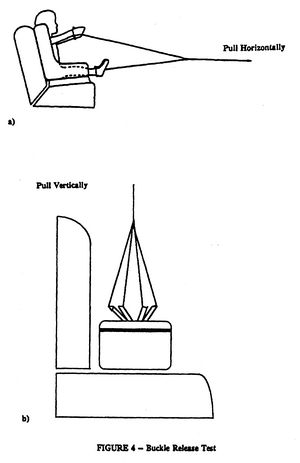 BILLING CODE 4910-59-C
Issued on March 8, 1994.
Barry Felrice,
Associate Administrator for Rulemaking.
[FR Doc. 94-5768 Filed 3-15-94; 8:45 am]
BILLING CODE 4910-59-M
BILLING CODE 4910-59-C
Issued on March 8, 1994.
Barry Felrice,
Associate Administrator for Rulemaking.
[FR Doc. 94-5768 Filed 3-15-94; 8:45 am]
BILLING CODE 4910-59-M